
Alzheimer's Disease (AD) Research
Overview of Alzheimer's Disease
Alzheimer's Disease (AD) is the leading cause of dementia worldwide. Clinically, it is characterized by the presence of extracellular amyloid plaques and intracellular neurofibrillary tangles, which result in neuronal dysfunction and cell death. Genome-wide association studies (GWAS) have identified a cohort of risk genes associated with late-onset AD (LOAD), including, but not limited to APOE, BIN1, SORL1, TREM2, EphA1, MEF2C, ABCA7, and PTK2B.
Key Risk Genes and Mechanisms
APOE has three allele variants; ApoE2, ApoE3, and ApoE4; with ApoE4 associated with an increased risk of AD. Evidence suggests that this risk occurs through promotion of amyloid-beta plaque aggregation. ApoE4 is also associated with impaired microglial response, lipid transport, synaptic integrity and plasticity, glucose metabolism, and cerebrovascular integrity.
Mutations in BIN1, primarily involved in endocytosis and maintaining cytoskeletal integrity in the brain, are suggested to play a role in the aggravation of tau pathology. Increased levels of BIN1 have been seen in AD postmortem brain tissue.
SORL1 expression is decreased in the brain of AD patients. Studies have demonstrated a role for SORL1 as a neuronal sorting receptor that binds amyloid precursor protein (APP) and regulates its trafficking and proteolytic processing, thus regulating β-amyloid (Aβ) peptide production.
The triggering receptor expressed on myeloid cells 2 (TREM2) is an innate immune receptor that is expressed on the cell surface of microglia, macrophages, osteoclasts, and immature dendritic cells. Research studies using AD mouse models indicate that deficiency and haploinsufficiency of TREM2 can lead to increased Aβ accumulation due to dysfunctional microglia response.
EphA1 is a member of the ephrin family of receptor tyrosine kinases responsible for regulating cell morphology and motility. In the central nervous system (CNS), EphA1 plays a role in synaptic plasticity and axon guidance. EphA1 is involved in inflammatory signaling pathways, which may mean it plays a role in regulation of neuroinflammatory processes in AD (13).
ATP-binding cassette sub-family A member 7 (ABCA7) functions to regulate phospholipid and cholesterol homeostasis in the CNS. ABCA7 dysfunction may contribute directly to AD pathogenesis by accelerating Aβ production and/or altering microglia-dependent phagocytosis of Aβ.
MEF2C is a member of the myocyte enhancer factor 2 (MEF2) family of transcription factors shown to play a role in learning and memory formation through regulation of synaptic plasticity. Studies have shown that MEF2C may play a role in age-related microglial activation through IFN-I associated MEF2C deregulation. MEF2C may also act as a modulator for APP proteolytic processing of Aβ.
Protein tyrosine kinase, Pyk2, encoded by the PTK2B gene, is a non-receptor tyrosine kinase highly expressed in neurons with implications in synaptic plasticity. In mouse models, knockout of Pyk2 impairs hippocampal-dependent memory and long-term potentiation. Overexpression of Pyk2 has been shown to protect neurons against Aβ42-induced synaptotoxicity. Pyk2 may also act as a kinase for tau phosphorylation and has been implicated as a modulator of tau toxicity.
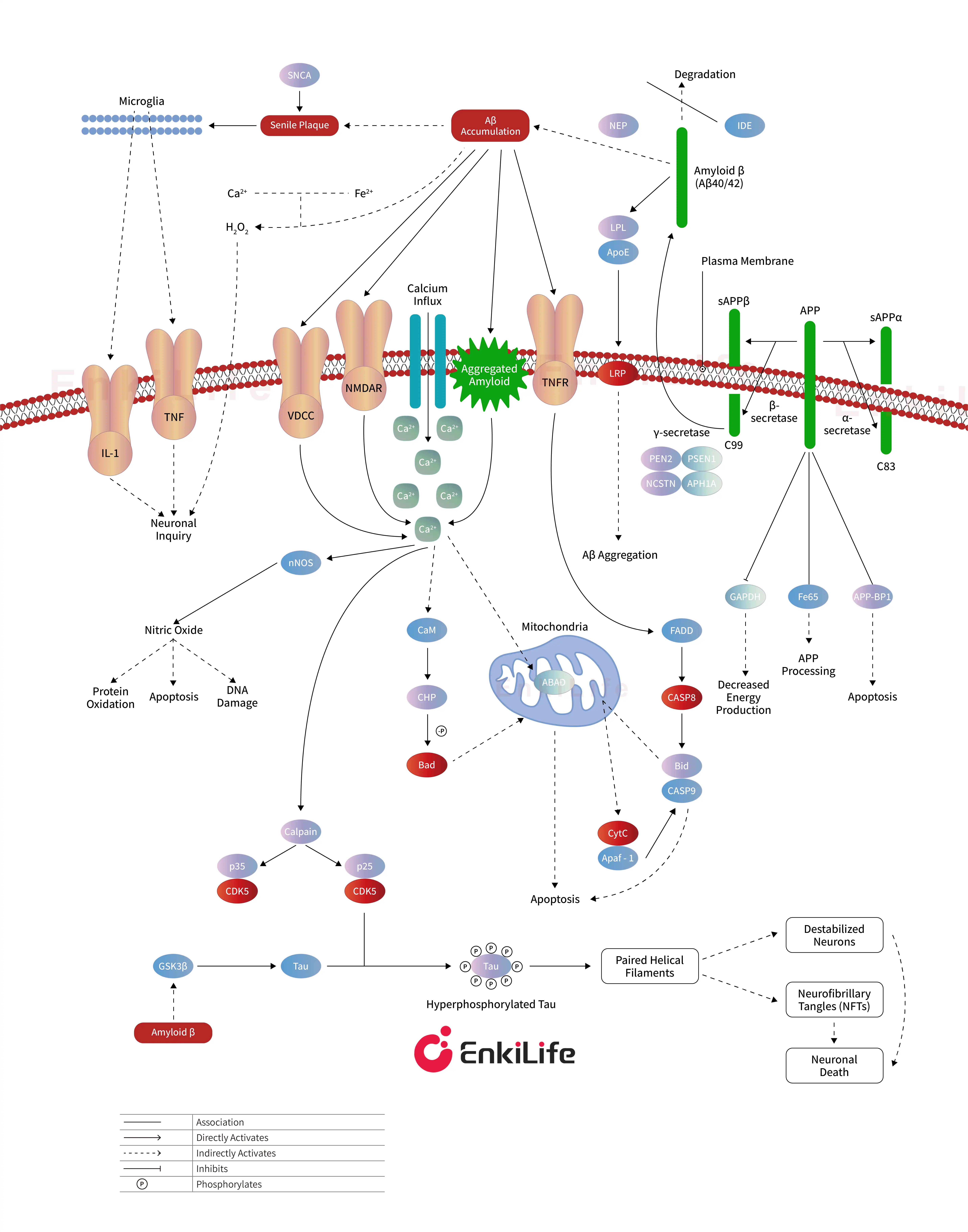
Alzheimer's Disease Mechanism Diagram
Relevant Antibodies
| Catalog# | Product Name | Reactivity | Application |
|---|---|---|---|
| AMRe21375 | Amyloid-β Rabbit Monoclonal antibody | Human,Mouse,Rat | WB,IHC,IF,IP,ELISA |
| AMM82586 | NEFL Mouse Monoclonal Antibody | Human,Mouse,Rat,Rabbit | WB,IHC,FC,ELISA |
| AMM83407 | Tau Mouse Monoclonal Antibody | Human | WB,IHC |
| AMRe86907 | BACE1 (DGR16768) Rabbit mAb | Human,Mouse,Rat | WB, IP |
| AMRe21375 | Amyloid-β Rabbit Monoclonal antibody | Human,Mouse,Rat | WB,IHC,IF,IP,ELISA |
| AMRe21060 | Synuclein-α Rabbit Monoclonal antibody | Human,Mouse,Rat | WB,IHC,IF,IP,ELISA |
| AMRe21445 | GSK3α Rabbit Monoclonal antibody | Human,Mouse,Rat | WB,IHC,IF,IP,ELISA |
| APRab04751 | GSK3α (phospho Ser21) Rabbit Polyclonal Antibody | Human,Mouse,Rat | WB,IHC-P,IF-P,IF-F,ICC/IF,IP,ELISA |
| APS0631 | HRP-conjugated Polyclonal Goat Anti-Mouse IgG(H+L) Secondary Antibody | ||
| APS0635 | HRP-conjugated Polyclonal Goat Anti-Rabbit IgG(H+L) Secondary Antibody | ||
| AMre80004 | GAPDH (12R9) Rabbit Monoclonal Antibody |
Related Products
Super-sensitive ECL chemiluminescent reagent
References
Selkoe DJ. Alzheimer's disease: genes, proteins, and therapy. Physiol Rev. 2001 Apr;81(2):741-66.[PMID: 11274343].
Franzmeier N, Rubinski A, Neitzel J, Ewers M; Alzheimer’s Disease Neuroimaging Initiative (ADNI). The BIN1 rs744373 SNP is associated with increased tau-PET levels and impaired memory. Nat Commun. 2019 Apr 16;10(1):1766. [PMID: 30992433].
Wang N, Lan D, Gerbod-Giannone M, Linsel-Nitschke P, Jehle AW, Chen W, Martinez LO, Tall AR. ATP-binding cassette transporter A7 (ABCA7) binds apolipoprotein A-I and mediates cellular phospholipid but not cholesterol efflux. J Biol Chem. 2003 Oct 31;278(44):42906-12.[PMID: 12917409].
Giralt A, Brito V, Chevy Q, Simonnet C, Otsu Y, Cifuentes-Díaz C, de Pins B, Coura R, Alberch J, Ginés S, Poncer JC, Girault JA. Pyk2 modulates hippocampal excitatory synapses and contributes to cognitive deficits in a Huntington's disease model. Nat Commun. 2017 May 30;8:15592.[PMID: 28555636].
Dourlen P, Fernandez-Gomez FJ, Dupont C, Grenier-Boley B, Bellenguez C, Obriot H, Caillierez R, Sottejeau Y, Chapuis J, Bretteville A, Abdelfettah F, Delay C, Malmanche N, Soininen H, Hiltunen M, Galas MC, Amouyel P, Sergeant N, Buée L, Lambert JC, Dermaut B. Functional screening of Alzheimer risk loci identifies PTK2B as an in vivo modulator and early marker of Tau pathology. Mol Psychiatry. 2017 Jun;22(6):874-883.[PMID: 27113998].
 | Flora Flora is a technical support expert at EnkiLife, familiar with immunology and neuroscience, dedicated to providing customers with high-quality product combinations and technical support to help achieve research in neurodegenerative diseases and other neuroscience areas. |