
Glycolysis/TCA Cycle Molecular Checkpoint
Glycolysis Overview
Glycolysis is the metabolic process by which glucose is converted to pyruvate in a sequence of enzymatic steps. Hexokinase catalyzes the conversion of glucose to glucose-6-phosphate, the first step in glycolysis. Hexokinases I, II, and III are associated with the outer mitochondrial membrane and are critical for maintaining an elevated rate of aerobic glycolysis in cancer cells (Warburg effect).
Phosphofructokinase (PFK) catalyzes the phosphorylation of fructose-6-phosphate. Platelet-type phosphofructokinase (PFKP) is expressed in various cell types. Glyceraldehyde-3-phosphate dehydrogenase (GAPDH) catalyzes the phosphorylation of glyceraldehyde-3-phosphate.
Pyruvate kinase, a glycolytic enzyme, catalyses the conversion of phosphoenolpyruvate to pyruvate. In mammals, the M1 isoform (PKM1) is expressed in most adult tissues. The M2 isoform (PKM2), an alternatively-spliced variant of M1, is expressed during embryonic development.
Lactate dehydrogenase (LDH) catalyzes the interconversion of pyruvate and NADH to lactate and NAD+. LDHA expression is induced when the oxygen supply is too low for mitochondrial ATP production.
The pyruvate dehydrogenase complex catalyzes the conversion of pyruvate and CoA into acetyl-CoA and CO₂ in the presence of NAD+. The reaction of oxidative decarboxylation of pyruvate serves as a critical link between glycolysis and the citric acid cycle and lipid metabolism.
Metabolic Pathway Diagram
Glucose → GLUT → Plasma membrane → Cytoplasm → Glucose → Glucose-6-phosphate → Glycogen biosynthesis; 6-Phosphoglucono-δ-lactone → Nucleotide biosynthesis; Fructose-6-phosphate → Glucosamine-6-phosphate → Glucosamine biosynthesis; Fructose-1,6-bisphosphate → Glyceraldehyde-3-phosphate / Dihydroxyacetone phosphate → Glycerol-3-phosphate → Lipid biosynthesis; NADH → 1,3-Bisphosphoglycerate → ATP → 3-Phosphoglycerate → 3-Phosphohydroxypyruvate → Amino acid biosynthesis; 2-Phosphoglycerate → Phosphoenolpyruvate → ATP → Pyruvate → Lactate; NAD+ ↔ NADH.
Functions: Energy exchange, Allosteric regulation, Metabolic flux regulation, Regulation of intracellular protein homeostasis, Redox balance, NAD+-dependent deacetylation, ADP-ribosylation, Intracellular Ca²⁺ homeostasis, Immune responses, Genomic stability.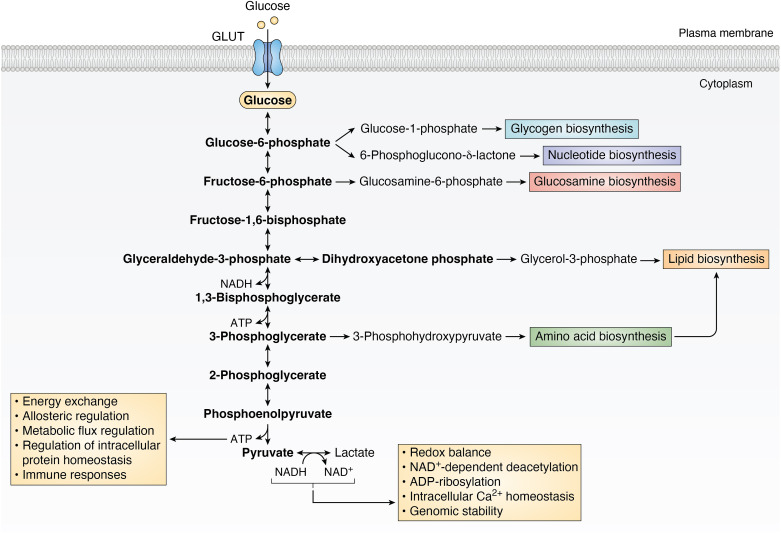
Relevant Antibodies
| Catalog# | Product Name | Reactivity | Application |
|---|---|---|---|
| AMRe05965 | Phospho-PDHA1 (S293) (17H17) Rabbit Monoclonal Antibody | Human,Mouse,Rat | WB,IHC-P,IP,IF-P |
| AMRe21508 | Pyruvate Dehydrogenase E1 α Rabbit Monoclonal antibody | Human,Mouse,Rat | WB,IHC,IF,IP,ELISA |
| AMRe15915 | PDK1 (9S9) Rabbit Monoclonal Antibody | Human,Mouse,Rat | WB,IP |
| AMRe21598 | Lactate Dehydrogenase Isoenzyme V Rabbit Monoclonal antibody | Human,Mouse,Rat | WB,IHC,IF,IP,ELISA |
| AMRe13264 | LDHB (13O6) Rabbit Monoclonal Antibody | Human | WB,IHC-P |
| APS0635 | HRP-conjugated Polyclonal Goat Anti-Rabbit IgG(H+L) Secondary Antibody | - | - |
| AMre80004 | GAPDH (12R9) Rabbit Monoclonal Antibody | - | - |
Related Products
References
- Strumiło S. Short-term regulation of the mammalian pyruvate dehydrogenase complex. Acta Biochim Pol. 2005;52(4):759-64. Epub 2005 Jul 11. [PMID: 16025163].
- Fan J, Kang HB, Shan C, Elf S, Lin R, Xie J, Gu TL, Aguiar M, Lonning S, Chung TW, Arellano M, Khoury HJ, Shin DM, Khuri FR, Boggon TJ, Kang S, Chen J. Tyr-301 phosphorylation inhibits pyruvate dehydrogenase by blocking substrate binding and promotes the Warburg effect. J Biol Chem. 2014 Sep 19;289(38):26533-26541. [PMID: 25104357].
- Hong SM, Lee YK, Park I, Kwon SM, Min S, Yoon G. Lactic acidosis caused by repressed lactate dehydrogenase subunit B expression down-regulates mitochondrial oxidative phosphorylation via the pyruvate dehydrogenase (PDH)-PDH kinase axis. J Biol Chem. 2019 May 10;294(19):7810-7820. [PMID: 30923124].
- Kierans SJ, Taylor CT. Glycolysis: A multifaceted metabolic pathway and signaling hub. J Biol Chem. 2024 Nov;300(11):107906. [PMID: 39442619; PMCID: PMC11605472.]
 | Flora Flora is a technical support expert at EnkiLife, familiar with immunology and neuroscience, dedicated to providing customers with high-quality product combinations and technical support to help achieve research in neurodegenerative diseases and other neuroscience areas. |