
Di-Methyl-Histone H3
Introduction
The nucleosome, made up of four core histone proteins (H2A, H2B, H3, and H4), is the primary building block of chromatin. Originally thought to function as a static scaffold for DNA packaging, histones have now been shown to be dynamic proteins, undergoing multiple types of post-translational modifications, including acetylation, phosphorylation, methylation, and ubiquitination.
Histone methylation is a major determinant for the formation of active and inactive regions of the genome and is crucial for the proper programming of the genome during development. Arginine methylation of histones H3 (Arg2, 17, 26) and H4 (Arg3) promotes transcriptional activation and is mediated by a family of protein arginine methyltransferases (PRMTs), including the co-activators PRMT1 and CARM1 (PRMT4).
In contrast, a more diverse set of histone lysine methyltransferases has been identified, all but one of which contain a conserved catalytic SET domain originally identified in the Drosophila Su(var)3-9, Enhancer of zeste, and Trithorax proteins. Lysine methylation occurs primarily on histones H3 (Lys4, 9, 27, 36, 79) and H4 (Lys20) and has been implicated in both transcriptional activation and silencing.
Methylation of these lysine residues coordinates the recruitment of chromatin modifying enzymes containing methyl-lysine binding modules such as chromodomains (HP1, PRC1), PHD fingers (BPTF, ING2), tudor domains (53BP1), and WD-40 domains (WDR5). The discovery of histone demethylases, such as PADI4, LSD1, JMJD1, JMJD2, and JHDM1, has shown that methylation is a reversible epigenetic marker.
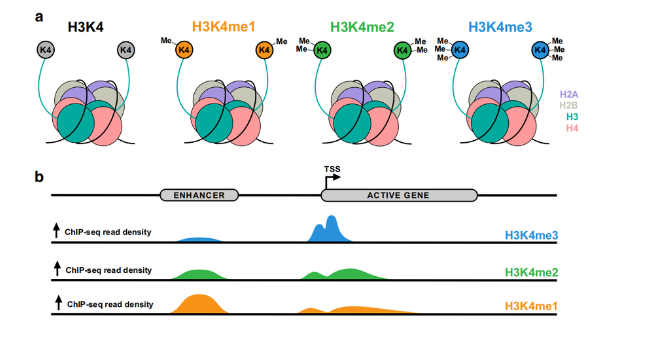
Different methylation modifications of lysine 4 of histone H3 (H3K4me1, H3K4me2, H3K4me3) and their distribution in gene regulatory regions (enhancers and active genes)
Relevant Antibodies
| Catalog# | Product Name | Reactivity | Application |
|---|---|---|---|
| AMRe87485 | DiMethyl-Histone H3 (Lys4) Rabbit Monoclonal Antibody | Human, Mouse, Rat | WB, IHC-P, ICC/IF, FC, IP |
| AMRe03935 | DiMethyl-Histone H3 (Lys9) Rabbit Monoclonal Antibody | Human, Rat | WB, IHC-F, IHC-P, ICC/IF |
| AMRe03906 | DiMethyl-Histone H3 (Lys36) Rabbit Monoclonal Antibody | Human, Mouse, Rat | WB, IHC-F, IHC-P, ICC/IF |
| AMM84831 | DiMethyl-Histone H3 (Lys27) Mouse Monoclonal Antibody | Human, Mouse, Rat | WB, IP, ICC |
| AMRe03979 | DiMethyl-Histone H3 (Lys79) Rabbit Monoclonal Antibody | Human, Mouse, Rat | WB, IHC-F, IHC-P, ICC/IF |
| AMRe21336 | Histone H3 Rabbit Monoclonal antibody | Human, Mouse, Rat | WB, IHC, IF, IP, ELISA |
| APS0635 | HRP-conjugated Polyclonal Goat Anti-Rabbit IgG(H+L) Secondary Antibody | Rabbit | ELISA, WB, Dot blot |
| AMre80004 | GAPDH (12R9) Rabbit Monoclonal Antibody | Human, Mouse, Rat, Rabbit, Dog, Monkey | WB, ELISA |
Related Products
References
- Peterson CL, Laniel MA. Histones and histone modifications. Curr Biol. 2004 Jul 27;14(14):R546-51. [PMID: 15268870].
- Kubicek S, Schotta G, Lachner M, et,al. The role of histone modifications in epigenetic transitions during normal and perturbed development. Ernst Schering Res Found Workshop. 2006;(57):1-27. [PMID: 16568946].
- Daniel JA, Pray-Grant MG, Grant PA. Effector proteins for methylated histones: an expanding family. Cell Cycle. 2005 Jul;4(7):919-26. Epub 2005 Jul 5. [PMID: 15970672].
- Wysocka J, Swigut T, Xiao H, et,al. A PHD finger of NURF couples histone H3 lysine 4 trimethylation with chromatin remodelling. Nature. 2006 Jul 6;442(7098):86-90.Epub 2006 May 21. [PMID: 16728976].
- Wysocka J, Swigut T, Milne TA, et,al. WDR5 associates with histone H3 methylated at K4 and is essential for H3 K4 methylation and vertebrate development. Cell. 2005 Jun 17;121(6):859-72. 2005.03.036. [PMID: 15960974].
- Trojer P, Reinberg D. Histone lysine demethylases and their impact on epigenetics. Cell. 2006 Apr 21;125(2):213-7.2006.04.003. [PMID: 16630806].
 | Flora Flora is a technical support expert at EnkiLife, familiar with immunology and neuroscience, dedicated to providing customers with high-quality product combinations and technical support to help achieve research in neurodegenerative diseases and other neuroscience areas. |