
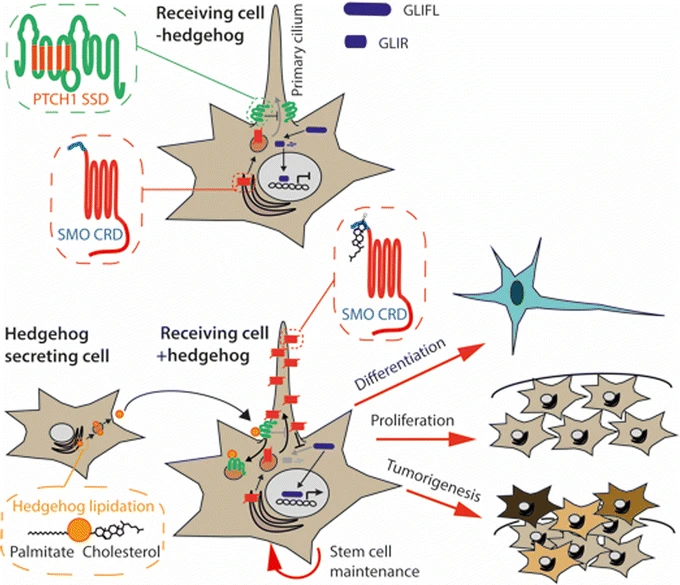
 Hedgehog proteins are secreted ligands that enable long-range communication between cells of developing and adult tissues. The core molecular components of the pathway are evolutionarily conserved and were first identified in the fruit fly Drosophila melanogaster nearly a century ago, first through mutant analysis and later by systematic genetic screens. These studies elucidated the signaling mechanism by which cells sense the concentration of hedgehog in their vicinity, which in certain contexts can be integrated with the duration of hedgehog exposure. These signal transduction events converge onto downstream gene-regulatory networks to regulate processes including cell proliferation, stem cell maintenance, survival, and fate specification. Many of the genes that encode hedgehog pathway components have subsequently been associated with a range of inherited human developmental disorders and other pathologies. The phenotype of congenital hedgehog deficiency is similar to that seen with genetic mutations causing defective cholesterol metabolism. At the molecular level, three observations link hedgehog signal transduction with cholesterol biosynthesis: hedgehog ligands are covalently modified by cholesterol; the hedgehog receptor patched (PTCH) contains a sterol-sensing domain (SSD), which is found in proteins involved in cholesterol synthesis and transport; and cholesterol, its precursors, and derivatives activate or inhibit smoothened (SMO), the membrane transducer of hedgehog signaling.
Product List
| Target | Catalog# | Product Name | Reactivity | Application |
|---|---|---|---|---|
Tyrosine Hydroxylase (14U19) | Tyrosine Hydroxylase (14U19) Rabbit Monoclonal Antibody | Human,Mouse,Rat | WB,IHC-P,ICC/IF |
Related Products
Super-sensitive ECL chemiluminescent reagent
References
- Lipid metabolism fattens up hedgehog signaling. Blassberg R, Jacob J. BMC Biol. 2017. [PMID: 29073896]
- Secretion and localized transcription suggest a role in positional signaling for products of the segmentation gene hedgehog. Lee JJ, et al. Cell. 1992. [PMID: 1394430]
- Hedgehog signaling in animal development: paradigms and principles. Ingham PW, McMahon AP. Genes Dev. 2001. [PMID: 11731473]
- Drosophila Segment Polarity Mutants and the Rediscovery of the Hedgehog Pathway Genes. Ingham PW. Curr Top Dev Biol. 2016. [PMID: 26970635]
- Mutations affecting segment number and polarity in Drosophila. Nüsslein-Volhard C, Wieschaus E. Nature. 1980. [PMID: 6776413]
- Transducing Hedgehog: the story so far. Ingham PW. EMBO J. 1998. [PMID: 9649421]
- The mechanisms of Hedgehog signalling and its roles in development and disease. Briscoe J, Thérond PP. Nat Rev Mol Cell Biol. 2013. [PMID: 23719536]
- Morphogen interpretation: the transcriptional logic of neural tube patterning. Cohen M, et al. Curr Opin Genet Dev. 2013. [PMID: 23725799]
- Gli proteins in development and disease. Hui CC, Angers S. Annu Rev Cell Dev Biol. 2011. [PMID: 21801010]
- Malformation syndromes caused by disorders of cholesterol synthesis. Porter FD, Herman GE. J Lipid Res. 2011. [PMID: 20929975]
- beta-Hydroxy-beta-methyl-glutaryl coenzyme A reductase, cleavage and condensing enzymes in relation to cholesterol formation in rat liver. BUCHER NL, et al. Biochim Biophys Acta. 1960. [PMID: 13805544]