
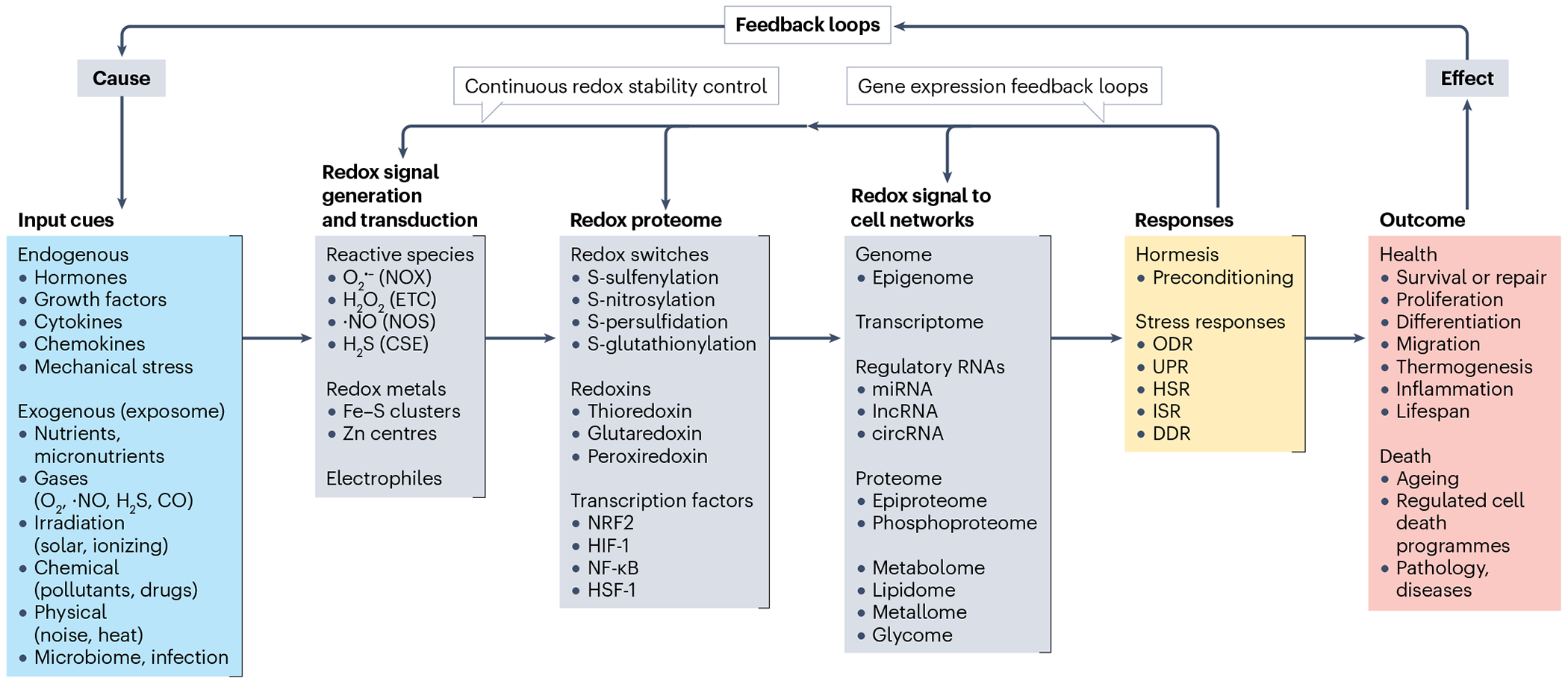
Redox homeostasis denotes the maintenance of the balance between oxidants and antioxidants. Although excessive oxidant production causes oxidative damage to cellular biomolecules and results in oxidative distress, lack of adequate oxidant levels impairs crucial signalling processes and results in reductive distress. The balance between oxidants and antioxidants is obtained by redox regulation, which encompasses redox sensing, redox signalling, redox responses and feedback control pathways. Reduction of oxidative modification is driven by the reductive power of NADPH and NADH, which serve as ‘ideal packets of diffusible two-electron transfer currency’ to maintain the redox state of hundreds of different proteins and small molecules.
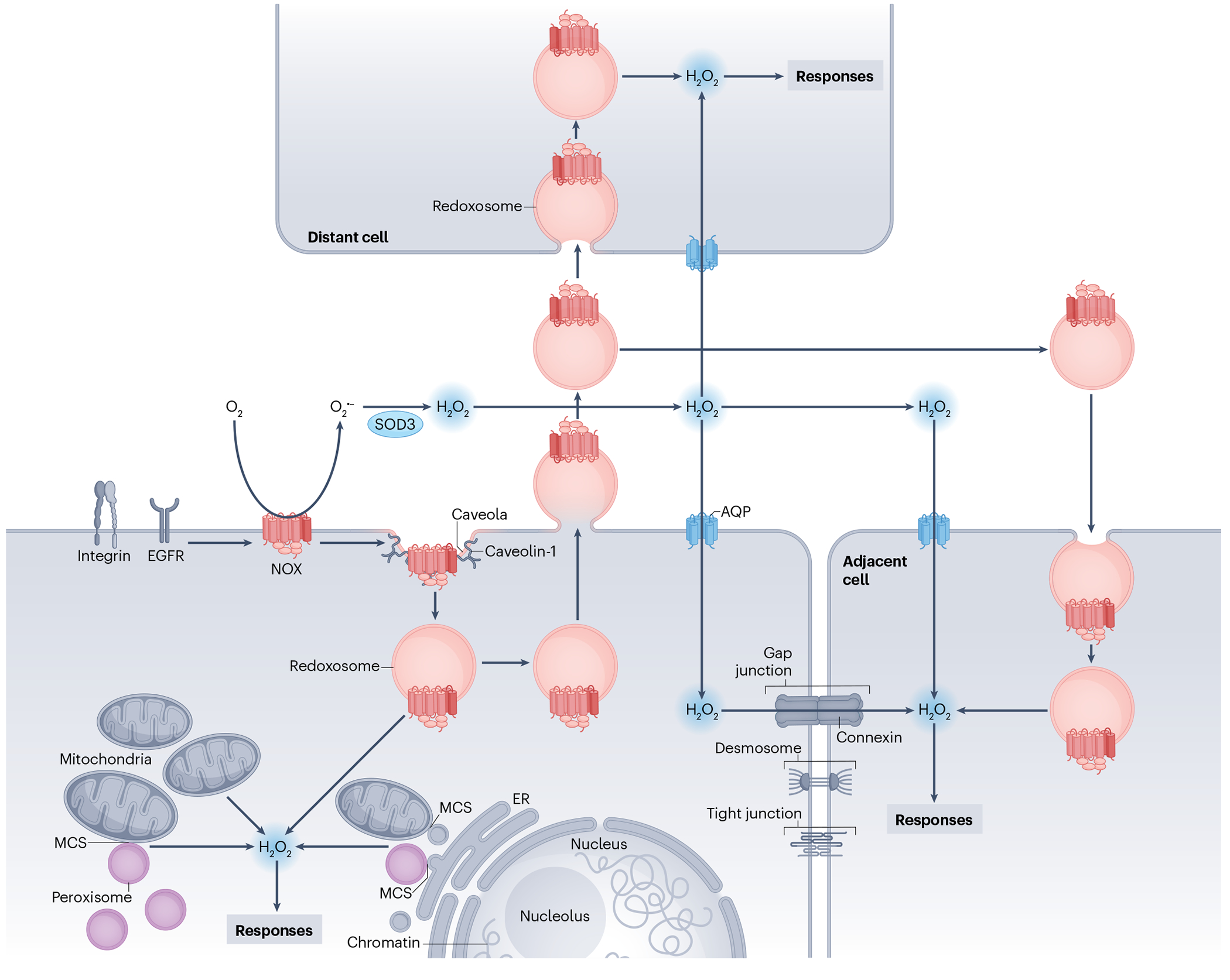
This simplified scheme focuses on H2O2 as a major cellular signalling oxidant. Plasma membrane-located NADPH oxidase (NOX) generates O2•− extracellularly, which is then dismutated to H2O2 by superoxide dismutase (SOD3). Entry of H2O2 into cells occurs either by transfer through peroxiporins, which are specialized aquaporins (AQPs), or by endocytosis to form redox-active endosomes, which have been named ‘redoxosomes’, formed predominantly at caveolae. Intracellularly, the organelles such as mitochondria, peroxisomes and the endoplasmic reticulum (ER) as well as around 40 oxidases produce H2O2 for signalling. The three organelles are in close contact, facilitated by tethering of their membranes at membrane contact sites (MCSs). Intercellular redox communication occurs by gap junctional communication through connexons, formed from two connexin hemichannels between directly adjacent cells, or by AQPs or endocytosis of extracellular vesicles (EVs), the redoxosomes mentioned earlier.
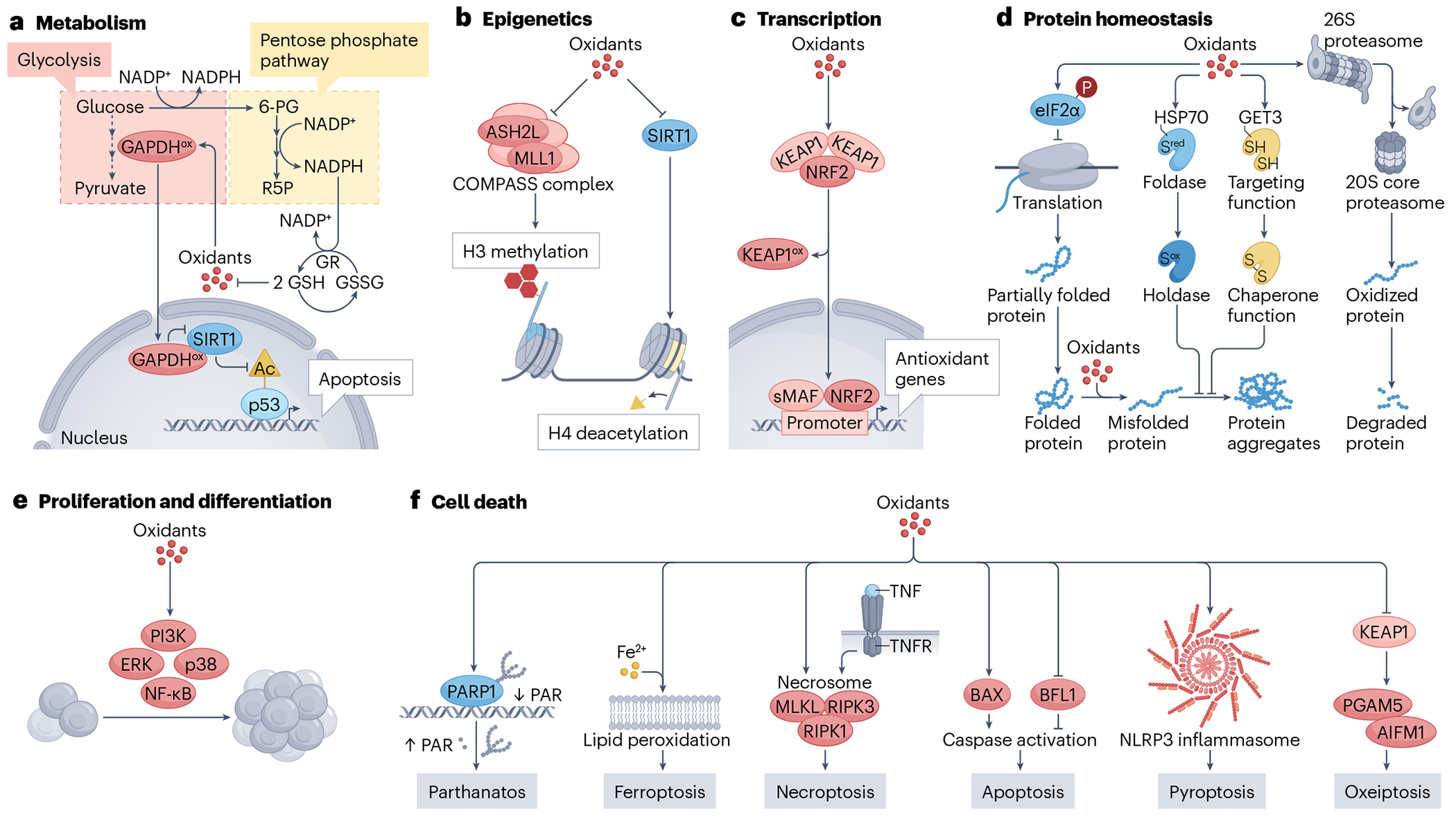
The cellular redox environment contributes to the regulation of most cellular processes through redox-regulated proteins. Some prominent examples of such processes are depicted in Fig. 3. The redox environment fine-tunes metabolic pathways and modulates the metabolome, which affects the activity of enzymes such as the NAD+-dependent histone deacetylases (that is, the sirtuins), and in response alters the epigenome. Redox-regulated histone modifier enzymes affect gene expression in response to changing oxidant levels, promoting potentially long-lasting and even transgenerational memory effects.
Product List
| Target | Catalog# | Product Name | Reactivity | Application |
|---|---|---|---|---|
| GPX1 | AMRe11726 | GPX1 (13J4) Rabbit Monoclonal Antibody | Human,Mouse,Rat | WB,IP |
| GPX4 | AMRe21183 | GPX4 Rabbit Monoclonal Antibody | Human,Mouse,Rat | WB,IHC,IF,ELISA |
| Thioredoxin | AMRe01313 | Thioredoxin Rabbit Monoclonal antibody | Human,Mouse,Rat | WB |
| Thioredoxin 2 | AMRe02686 | Thioredoxin 2 Rabbit Monoclonal Antibody | Human,Mouse,Rat | WB,IHC,ICC/IF |
| Thioredoxin Reductase 1 | AMRe02732 | Thioredoxin Reductase 1 Rabbit Monoclonal Antibody | Human,Mouse | WB,IHC,ICC/IF,IP |
| TXNIP | AMRe84024 | TXNIP Rabbit Monoclonal Antibody | Human,Mouse,Rat | WB,IHC,ICC/IF,ICC,FC |
| PRDX1 | AMRe83884 | PRDX1 Rabbit Monoclonal Antibody | Human,Mouse | WB,IHC,ICC/IF,ICC,FC |
Related Products
Super-sensitive ECL chemiluminescent reagent
References
- Fundamentals of redox regulation in biology. Sies H, et al. Nat Rev Mol Cell Biol. 2024. [PMID: 38689066]
- Metabolic Responses to Reductive Stress. Xiao W, et al. Antioxid Redox Signal. 2020. [PMID: 31218894]
- Eight Kinetically Stable but Thermodynamically Activated Molecules that Power Cell Metabolism. Walsh CT, et al. Chem Rev. 2018. [PMID: 29272116]
- Novel and Converging Ways of NOX2 and SOD3 in Trafficking and Redox Signaling in Macrophages. Petersen SV, et al. Antioxidants (Basel). 2021. [PMID: 33503855]
- Aquaporin-facilitated transmembrane diffusion of hydrogen peroxide. Bienert GP, et al. Biochim Biophys Acta. 2014. [PMID: 24060746]
- Mishina NM, Tyurin-Kuzmin PA, Markvicheva KN, Vorotnikov AV, Tkachuk VA, Does cellular hydrogen peroxide diffuse or act locally? Laketa V, et al. Antioxid Redox Signal. 2011. [PMID: 20690882]
- Signaling components of redox active endosomes: the redoxosomes. Oakley FD, et al. Antioxid Redox Signal. 2009. [PMID: 19072143]
- The basic biology of redoxosomes in cytokine-mediated signal transduction and implications for disease-specific therapies. Spencer NY, et al. Biochemistry. 2014. [PMID: 24555469]