
Polystyrene: The Unrivaled Choice for ELISA Solid-Phase Carriers

Enzyme-Linked Immunosorbent Assay (ELISA) is one of the most classic and widely used immunoassay techniques in modern life science research, clinical diagnosis, food safety testing, and environmental monitoring. Its core principle is to immobilize antigens or antibodies on a solid-phase carrier to construct a specific immune reaction system, and then achieve qualitative and quantitative detection of target substances through enzyme-catalyzed color development. As the "cornerstone" of the entire ELISA system, the material of the solid-phase carrier directly determines the coating efficiency of antigens/antibodies, the specificity of immune reactions, the stability of detection signals, and the reliability of experimental results. Among numerous polymer materials, polystyrene (PS) stands out due to its unique molecular structure, excellent physicochemical properties, precise optical adaptability, and mature industrial processing capabilities, becoming the only mainstream material for ELISA microplates worldwide and an irreplaceable choice. Based on the core requirements of ELISA experiments, this article will systematically analyze the underlying logic and unique advantages of polystyrene as an ELISA solid-phase carrier from six dimensions: molecular interaction mechanism, optical performance adaptation, chemical stability compatibility, surface modification potential, molding precision advantages, and material comparison analysis, clarifying the core reasons for its irreplaceability.
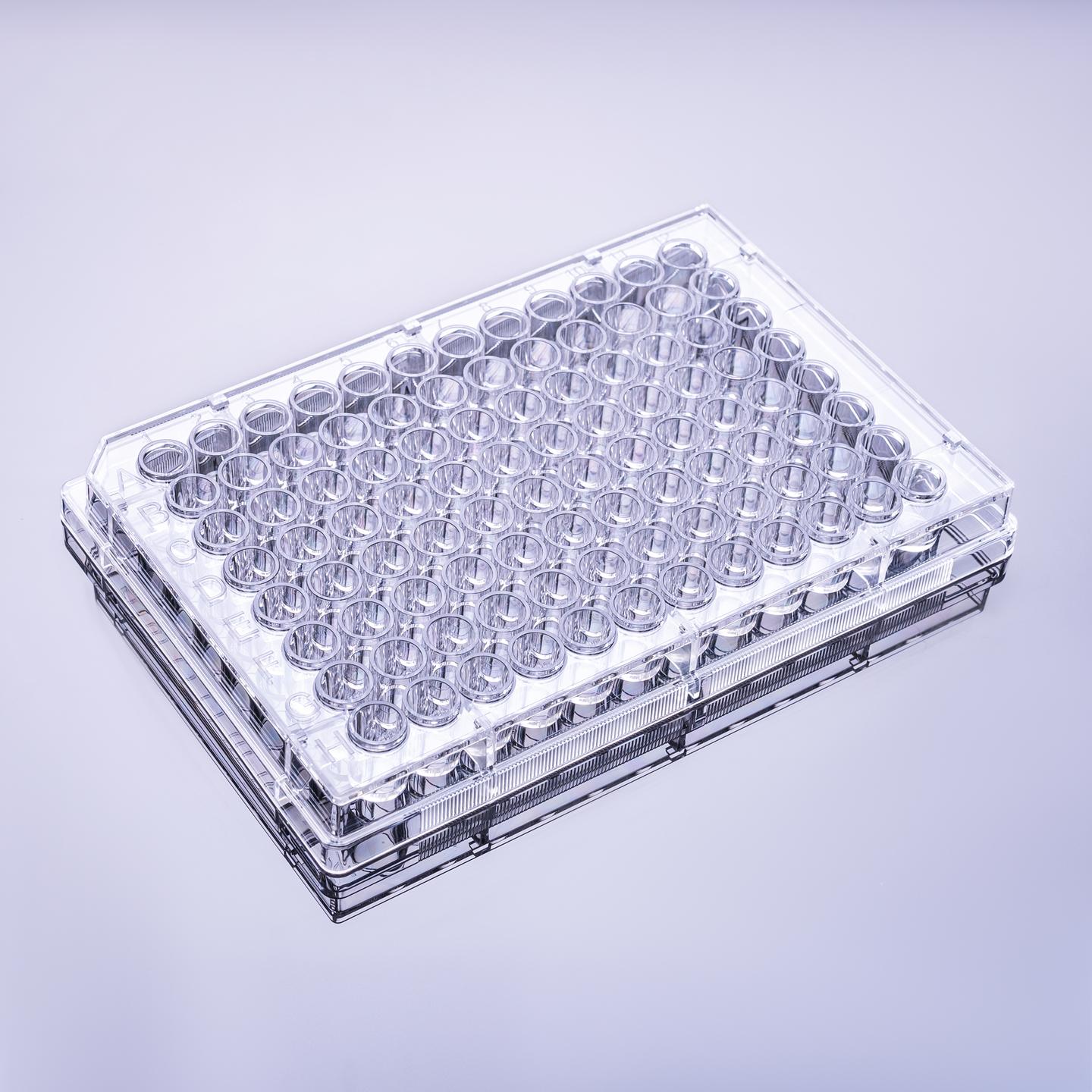
I. Molecular Structure Foundation: Hydrophobic Interactions Dominate Protein Stable Coating
The primary core requirement of ELISA experiments is to achieve firm and stable coating of antigens/antibodies on the surface of solid-phase carriers, which is the fundamental prerequisite for subsequent specific immune binding and enzyme-catalyzed color development. This process essentially relies on non-covalent interactions between the surface of the solid-phase carrier and protein molecules. The molecular structural characteristics of polystyrene precisely match this core requirement, where hydrophobic interactions serve as the core driving force for coating, and electrostatic interactions play an auxiliary reinforcing role.
1. Molecular Structural Characteristics of Polystyrene: Providing a Natural Basis for Protein Adsorption
Polystyrene is a typical non-polar aromatic polymer with a saturated carbon chain as the main chain, and each repeating unit is connected to a benzene ring side chain. This structure endows it with two key characteristics: first, strong hydrophobicity, with no polar groups such as hydroxyl, carboxyl, or amino groups in the molecular structure, resulting in extremely low surface energy and forming a stable hydrophobic interface; second, structural stability, where the conjugated system of benzene rings provides good rigidity to the molecular chain, making it resistant to deformation, while also providing structural support for the formation of π-π conjugate forces. This non-polar, strongly hydrophobic molecular structure is the natural basis for its efficient protein adsorption.
2. Dual Mechanism of Protein Adsorption: Achieving Stable and Irreversible Coating
The three-dimensional structure of protein molecules has distinct hydrophobic and hydrophilic regions: the interior of the molecule is rich in hydrophobic amino acid residues such as leucine, valine, and phenylalanine, while the surface is mainly composed of hydrophilic groups to adapt to the aqueous solution environment. In the neutral (pH 7.2-7.4 PBS buffer) or weakly alkaline (pH 9.4-9.6 carbonate buffer) environments commonly used in ELISA experiments, protein molecules undergo slight conformational changes, exposing the hydrophobic regions originally hidden inside the molecule, which become key binding sites for the polystyrene surface. Stable coating is achieved through dual effects:
Main Force: Hydrophobic Interactions. The core of the hydrophobic effect is that "hydrophobic substances aggregate with each other to reduce the contact area with water molecules", similar to how oil droplets on water always coalesce into large oil beads rather than dispersing and dissolving. Between the strong hydrophobicity of the polystyrene surface and the exposed hydrophobic regions of proteins, strong hydrophobic interactions occur, promoting the spontaneous aggregation and firm adsorption of protein molecules onto the polystyrene surface; meanwhile, the benzene rings on the polystyrene side chains form π-π conjugate forces with the benzene rings of aromatic amino acids in proteins, which, combined with van der Waals forces, further enhance the binding strength, making the adsorption irreversible and highly stable, effectively preventing protein detachment during subsequent washing and incubation processes and ensuring the smooth progress of experiments.
Auxiliary Force: Electrostatic Interactions. In the specific buffer environment of ELISA, protein molecules and the polystyrene surface carry weak charges - most proteins carry more negative charges under weakly alkaline conditions, and the polystyrene surface also carries weak opposite charges at the corresponding pH value. The electrostatic attraction between positive and negative charges further reinforces the binding between proteins and the carrier, especially for proteins with small molecular weights and few hydrophobic regions, the auxiliary effect is more significant.
3. Fatal Shortcomings of Other Plastic Materials: Unable to Meet Core Coating Requirements
Polypropylene (PP): With a saturated aliphatic hydrocarbon linear structure, it is highly non-polar and has extremely inert surface. Although it is hydrophobic, its molecular chain is regular and lacks effective binding sites for proteins, making it almost impossible to immobilize proteins through physical adsorption and completely unsuitable for ELISA solid-phase carriers.
Polyethylene (PE): A linear saturated alkane structure with highly inert molecules, extremely low surface energy, and superhydrophobicity. However, this super-inert surface hardly adsorbs any proteins and can only be used to make liquid storage consumables such as centrifuge tubes, unable to serve as a solid-phase carrier.
Polycarbonate (PC): Contains polar carbonate groups, with moderate surface polarity and relatively high surface energy. Protein adsorption relies only on weak polar interactions, resulting in low adsorption capacity, unstable binding, and easy detachment, making it unable to achieve stable coating.
Acrylic (PMMA): Has a polar acrylate structure with relatively high surface polarity and strong hydrophilicity. The hydrophilic groups on the protein surface repel the hydrophilic groups on the PMMA surface, resulting in extremely low protein adsorption capacity and inability to meet coating requirements.
Polyvinyl Chloride (PVC): Contains polar chlorine groups and a large amount of plasticizers. Protein adsorption is non-specific, easily causing non-specific adhesion of impurities. Not only is the coating efficiency low, but it also interferes with subsequent immune reactions.
II. Optical Performance Adaptation: Precise Matching for Microplate Reader Detection
One of the core steps in ELISA experiments is to detect absorbance (OD value) at specific wavelengths through a microplate reader to achieve quantitative analysis of target substances. This places stringent requirements on the optical performance of the solid-phase carrier - no background interference, uniform optical path, and good light transmission. The optical properties of polystyrene perfectly meet these requirements, making it an ideal material for microplate reader detection and a key advantage as an ELISA solid-phase carrier.
1. Wavelength Requirements for ELISA Detection and Optical Advantages of Polystyrene
Commonly used detection wavelengths in ELISA are concentrated at 405nm, 450nm, 490nm, and 630nm, covering the ultraviolet to visible light range. Different wavelengths correspond to different substrate color signals (e.g., TMB substrate color development is commonly detected at 450nm). As an amorphous non-crystalline polymer, polystyrene possesses three core optical advantages that precisely match detection requirements:
a. No Autofluorescence, Pure Background. Polystyrene itself has no autofluorescence property and does not produce fluorescent signals within the commonly used wavelength range of ELISA, effectively avoiding fluorescence background interference with detection results, preventing an increase in background OD values, reducing false positives, and ensuring the specificity and accuracy of detection.
b. Uniform Optical Path, Accurate Reading. Polystyrene has good optical isotropy, and during injection molding, it can form a uniform structure without grain boundaries or bubbles. The wall thickness and bottom flatness of each well in the microplate can be precisely controlled at the micrometer level. This high uniformity ensures that the optical path length of each well is completely consistent, with no scattering or refraction when light passes through, guaranteeing good consistency in absorbance values read by the microplate reader for each well, reducing inter-well errors, and improving experimental repeatability.
c. UV-Visible Light Transparent, No Characteristic Absorption. Polystyrene has good light transmittance in the UV to visible light range commonly used in ELISA, with no obvious characteristic absorption peaks, so it does not block or interfere with substrate color signals, allowing the microplate reader to accurately capture the intensity of color signals and ensuring accurate quantitative detection.
2. Optical Disadvantages of Other Plastic Materials: Unable to Adapt to Quantitative Detection Requirements
Polypropylene (PP), Polyethylene (PE): Both are translucent materials with grain boundaries in their molecular structures. Severe grain boundary scattering occurs when light passes through, resulting in significant deviations in absorbance readings and making precise quantification impossible; among them, PE is milky white and translucent, with more severe light scattering, almost unable to be used for optical detection.
Polycarbonate (PC): Although it has high transparency, it has slight autofluorescence, which increases the background OD value, interferes with the reading of detection signals, and easily leads to false positives; additionally, internal stress is easily generated during injection molding, causing birefringence and affecting the uniformity of the optical path.
Acrylic (PMMA): Has a light transmittance close to that of glass, but has obvious characteristic absorption in the UV region (especially around 450nm), directly interfering with the reading of key ELISA wavelengths and leading to inaccurate detection results.
Polyvinyl Chloride (PVC): Has average transparency and high autofluorescence. The precipitation of plasticizers further increases background interference, reducing the signal-to-noise ratio of detection and resulting in poor repeatability.
III. Excellent Chemical Stability: Perfectly Compatible with the Entire ELISA Reaction System
ELISA experiments involve contact with various reagents of different pH values and types throughout the process, including weakly alkaline coating solutions, neutral washing solutions, weakly acidic substrate solutions, and strongly acidic stop solutions, with the pH range of the reaction system covering 2-10. The solid-phase carrier must have good chemical stability, not swelling, not precipitating harmful substances, not reacting with reagents, and not destroying the spatial conformation of antigens/antibodies and enzyme activity - the chemical inertness of polystyrene precisely meets these stringent requirements and is the key to ensuring experimental reliability.
1. Perfect Compatibility Between Polystyrene and ELISA Reaction System
Polystyrene has excellent chemical inertness and can maintain structural stability throughout the entire ELISA experimental process, specifically manifested in three aspects:
a. Acid-Base Resistant, Non-Swelling. Within the pH range of 2-10, polystyrene does not swell, deform, or degrade, and can stably maintain the shape and structure of the microplate, avoiding inter-well errors or reagent leakage caused by carrier deformation; whether it is weakly alkaline carbonate coating solution, neutral PBST washing solution, weakly acidic TMB substrate solution, or dilute sulfuric acid stop solution, none of them will cause damage to it.
b. No Precipitation, No Interference. Pure polystyrene resin does not contain additives such as plasticizers or stabilizers, and no small molecules are precipitated during the reaction process, avoiding damage to the spatial conformation of antigens/antibodies by precipitates and also preventing inhibition of the activity of enzymes such as horseradish peroxidase (HRP), ensuring the normal progress of immune reactions and enzyme-catalyzed reactions.
c. Low Non-Specific Adsorption. The polystyrene surface has no polar groups or charged groups, and only specifically binds target antigens/antibodies through hydrophobic interactions, without non-specifically adsorbing substrates, enzyme-labeled secondary antibodies, small molecule impurities, etc.; subsequent PBST washing can completely elute unbound substances, reducing the background OD value, improving the signal-to-noise ratio, and ensuring the reliability and repeatability of experimental results.
2. Chemical Compatibility Defects of Other Plastic Materials: Prone to Causing Experimental Failure
Polycarbonate (PC): Although it has good impact resistance, it is not resistant to strong alkalis and halogenated hydrocarbons, and may undergo slight degradation under the action of weakly alkaline coating solutions; surface polar groups easily adsorb impurities, increasing background interference; degradation products may also damage the spatial conformation of antibodies, leading to inactivation of HRP enzymes.
Polyvinyl Chloride (PVC): A large amount of plasticizers added are easily precipitated in the reaction system, interfering with the specific binding between antigens and antibodies. At the same time, it non-specifically adsorbs impurities, resulting in extremely high background values and excessive CV (coefficient of variation), with poor experimental repeatability; additionally, it has poor chemical resistance and may be corroded under the action of dilute sulfuric acid stop solution.
Acrylic (PMMA): Is brittle and easily corroded by organic solvents such as alcohols and ketones. Methanol and other alcohol reagents occasionally used in ELISA experiments will cause damage to it; meanwhile, its hydrophilic properties make the surface easily adsorb water molecules to form a hydration film, further reducing protein coating efficiency.
Polypropylene (PP), Polyethylene (PE): Although they have strong chemical inertness and are resistant to acids, alkalis, and organic solvents, due to their extremely poor protein adsorption capacity, they cannot achieve stable coating. Even if their chemical stability is good, they cannot be used as ELISA solid-phase carriers.
IV. Surface Modifiability + Easy Molding: Adapting to Diverse Experiments and Industrial Production
ELISA experiments have a wide range of applications, involving different types of antigens/antibodies such as macromolecular proteins, small molecular peptides, and cytokines, with varying requirements for the binding capacity of solid-phase carriers; meanwhile, industrial mass production requires solid-phase carriers to have stable molding precision and batch repeatability. Polystyrene not only has excellent inherent properties but also possesses flexible surface modifiability and mature precision molding capabilities, which can simultaneously meet the diverse needs of scientific research experiments and the standardization requirements of industrial production, further consolidating its core position.
1. Flexible Surface Modifiability: Covering the Needs of All Types of ELISA Experiments
Native polystyrene has a moderately hydrophobic surface and mainly binds conventional macromolecular antigens/antibodies through hydrophobic interactions, which can meet the needs of most ELISA experiments. For special scenarios such as detection of small molecular peptides, weakly adsorbing proteins, and cytokines, its surface properties can be adjusted through mature modification techniques to adapt to different coating requirements:
a. Hydrophilic Modification: Through plasma treatment, γ-ray irradiation, chemical grafting, and other methods, polar groups such as hydroxyl and carboxyl groups are introduced onto the polystyrene surface to improve surface hydrophilicity, producing "high-binding plates", which can enhance the adsorption capacity for small molecular peptides and proteins with strong polarity, improve coating efficiency, and are suitable for detection of small molecular antigens/antibodies.
b. Surface Passivation Modification: Through chemical modification to block some hydrophobic binding sites on the polystyrene surface, reducing hydrophobicity, producing "low-binding plates", which are suitable for detection of cytokines and weakly adsorbing proteins, reducing non-specific adsorption, lowering background values, and improving detection specificity.
In addition, the polystyrene surface can be pre-coated with antibodies or antigens to produce pre-coated microplates, saving experimental time and improving efficiency for researchers. Currently, polystyrene surface modification processes are very mature and can achieve industrial mass production to meet experimental needs in different fields.
2. Mature Precision Molding Process: Ensuring Batch Repeatability and Standardization
ELISA experiments have extremely high requirements for the molding precision of microplates, especially for 96-well and 384-well microplates. Small deviations in indicators such as well spacing, well depth, bottom flatness, and wall thickness uniformity will affect the repeatability and accuracy of experiments. The excellent processing performance of polystyrene can perfectly meet the requirements of precision molding:
a. Good Melt Flowability: During injection molding, it can uniformly fill the details of the mold, ensuring consistent shape and size of each well.
b. Wide Injection Molding Temperature Range: The processing process is easy to control, effectively avoiding molding defects such as bubbles, deformation, and uneven wall thickness caused by temperature fluctuations.
c. Low Shrinkage Rate, Not Easy to Deform: After cooling, it can maintain the shape stability of the microplate for a long time, ensuring that indicators such as optical path length and volume of each well remain consistent.
These advantages enable polystyrene microplates to achieve micrometer-level precision control, with extremely small inter-well CV values for the entire plate. Intra-batch and inter-batch repeatability meet the strict standards of clinical diagnostic kits, providing a guarantee for the standardization and normalization of ELISA experiments. In contrast, other plastic materials either have high molding difficulty (such as PMMA which is brittle and easily broken) or low molding precision (such as PVC with high shrinkage rate and easy deformation), unable to meet the molding precision requirements of ELISA.
V. Comprehensive Comparison of Core Properties of Mainstream Plastic Materials
To more intuitively demonstrate the unique advantages of polystyrene as an ELISA solid-phase carrier, the following is a comprehensive comparison of its core properties with five other mainstream biochemical plastic materials, clarifying the advantages and disadvantages of various materials and their applicable scenarios, further confirming the irreplaceability of polystyrene:
MaterialMolecular Structural CharacteristicsProtein Adsorption CapacityOptical PropertiesChemical StabilitySurface ModifiabilityMolding PrecisionCore DefectsApplicable Scenarios
Polystyrene (PS)Carbon chain backbone + benzene ring side chains, non-polar aromatic structureExtremely strong (hydrophobic + π-π interaction + van der Waals forces, stable and irreversible binding)No autofluorescence, UV-visible transparent, uniform optical path, extremely low birefringenceResistant to pH 2-10, aqueous solutions, weak acids/bases, TMB/dilute sulfuric acid; not resistant to strong organic solventsStrong, can be flexibly modified through plasma treatment, γ-ray irradiation, etc.Extremely high, micrometer-level control, small inter-well CV valueOnly not resistant to strong organic solvents, which can be avoided in ELISA systemsELISA microplates, protein adsorption plates, cell culture plates
Polypropylene (PP)Saturated aliphatic hydrocarbon linear structure, highly non-polarExtremely poor, high surface inertness, almost no physical adsorptionTranslucent, grain boundary scattering, non-uniform opticsResistant to acids, alkalis, organic solvents, and high temperaturesWeak, high surface inertness, difficult to modifyGood, but non-uniform optics affect detectionExtremely poor protein adsorption capacity, unable to perform solid-phase coatingNon-detection consumables such as centrifuge tubes and liquid storage bottles
Polyethylene (PE)Linear saturated alkane, highly inert molecular structureAlmost no adsorption, extremely low surface energyMilky white translucent, severe light scatteringExtremely strong chemical inertness, resistant to high and low temperaturesExtremely weak, unable to perform effective modificationAverage, easy to deformNo solid-phase carrier capacity, unable to immobilize proteinsLiquid storage bags, cryogenic vials
Polycarbonate (PC)Contains polar carbonate groups, rigid macromoleculesWeak, adsorption mainly through weak polar interactions, easy to detachHigh transparency but with slight autofluorescence, prone to birefringenceImpact resistant, not resistant to halogenated hydrocarbons/strong alkalisModerate, complex modification processGood, but internal stress easily causes deformationHigh background fluorescence, interferes with reading; unstable protein bindingCell culture flasks (non-detection use)
Acrylic (PMMA)Polar acrylate structureWeak, hydrophilic repels proteins, extremely low adsorption capacityHigh light transmittance, but absorption in UV regionBrittle, easily corroded by alcohols/ketonesModerate, still unable to meet coating requirements after modificationAverage, brittle and easily brokenUV absorption interferes with ELISA wavelengths; proteins cannot be immobilizedTransparent containers (non-ELISA detection)
Polyvinyl Chloride (PVC)Contains polar chlorine groups, contains a large amount of plasticizersNon-specific, easily causes non-specific adhesion of impuritiesAverage transparency, high autofluorescencePlasticizers easily precipitated, poor chemical resistanceWeak, plasticizers affect modification effectPoor, high shrinkage rate, easy to deformPrecipitates interfere with immune reactions, high background values, poor CVOrdinary plastic containers, no detection use
VI. Conclusion: Fundamental Reasons for the Irreplaceability of Polystyrene
Based on the above analysis, the core reason why polystyrene has become the unrivaled choice for ELISA solid-phase carriers lies in its perfect balance of the four core requirements of ELISA experiments - stable protein coating, precise optical detection, full-system chemical compatibility, and diverse applications with standardized production, which no other plastic material can match.
From the perspective of the core process of ELISA experiments, at the molecular level, the non-polar aromatic structure of polystyrene endows it with strong hydrophobicity. Through the synergistic effect of hydrophobic interactions, π-π conjugate forces, and van der Waals forces, it achieves stable and efficient coating of antigens/antibodies, solving the fundamental problem of ELISA experiments; at the optical level, its properties of no autofluorescence, uniform optical path, and good light transmittance precisely meet the full-wavelength detection requirements of microplate readers, ensuring the accuracy of quantitative results; at the chemical level, its excellent chemical inertness makes it perfectly compatible with the entire ELISA reaction system, without interfering with immune and enzyme-catalyzed reactions, ensuring the reliability of experimental results; at the application and production level, its flexible surface modifiability covers diverse experimental scenarios, and its mature precision molding process ensures batch repeatability, meeting the standardization requirements of scientific research and clinical diagnosis.
In contrast, other plastic materials all have at least one fatal shortcoming: PP and PE have insufficient protein adsorption capacity and cannot achieve stable coating; PC and PMMA have defects in optical performance, interfering with detection readings; PVC has poor chemical stability, easily destroying the experimental system; the molding precision or modification capabilities of various materials also cannot simultaneously meet the diverse requirements of ELISA. Therefore, the global adoption of polystyrene as the material for ELISA microplates is not a subjective choice of the industry but an inevitable result determined by its underlying physicochemical properties.

With the continuous development of ELISA technology, the performance requirements for solid-phase carriers continue to increase. However, relying on its unique advantages and continuously optimized modification and molding processes, polystyrene will continue to maintain its dominant position in the field of ELISA solid-phase carriers for a long time, becoming an indispensable core consumable in life science research and clinical diagnosis.

EnkiLife ELISA Kits

   💬 WhatsApp