
Host Cell Viral Restriction Factor Antibody
Viral restriction factors are proteins produced by host cells that function, in part, to negatively impact various stages of viral life cycles in order to prevent propagation. MX1 (Myxovirus resistance protein 1/MxA) is an interferon-inducible antiviral protein that confers resistance to RNA viruses by blocking transcription of the viral genome (1,2). 2'-5'-oligoadenylate synthetase 1 (OAS1) is an antiviral protein induced by type 1 interferon that plays a key role in the cellular innate immune response (3). The OAS1 enzyme produces a second messenger, 2'-5'-linked oligoadenylate, which binds to RNase L, which then degrades viral and cellular RNA (4). Research studies indicate that the OAS1 system inhibits protein synthesis and induces apoptosis in virally infected cells, which limits viral infection (5). Interferon-induced transmembrane protein (IFITM) family members, IFITM1 and IFITM3, appear to function as viral restriction factors by preventing fusion of viral and host membranes (6,7). BST2 (CD317, Tetherin, HM1.24) is a type II transmembrane glycoprotein functioning as a major mediator of the innate immune defense against the dissemination of enveloped viruses by tethering viron on the cell surface, preventing viral release (8). TRIM5α blocks viral infection by interacting with the incoming viral capsid and promoting its premature disassembly (9). PKR-induced phosphorylation of the eukaryotic initiation factor 2 (eIF2) α subunit at Ser51 is a well-documented mechanism to downregulate protein synthesis upon viral infection (10). SAM domain and HD domain-containing protein 1 (SAMHD1) prevents autoimmunity and HIV infection by hydrolyzing intracellular deoxynucleoside triphosphates (dNTPs), thereby limiting inappropriate immune activation by self nucleic acid and inhibiting reverse transcription of the HIV genome (11). Phosphorylation of SAMHD1 at Thr592 by cyclin A2/CDK1 was identified as a regulatory mechanism to control its activity.
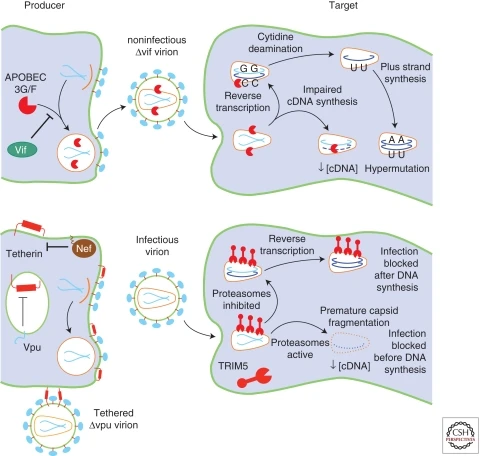
Mechanisms of restriction factor function and evasion.
Relevant Antibodies
| Catalog# | Product Name | Application | Reactivity |
|---|---|---|---|
| AMRe21071 | MX1 Rabbit Monoclonal antibody | WB,IHC,IF,IP,ELISA | Human,Mouse,Rat |
| AMRe84271 | RNaseL Rabbit Monoclonal | WB | Human |
| AMRe21583 | IFITM3 Rabbit Monoclonal antibody | WB,IHC,IF,IP,ELISA | Human,Mouse,Rat |
| AMRe07675 | BST2 (1O19) Rabbit Monoclonal Antibody | WB | Human |
| AMM80513 | Trim5a Mouse Monoclonal Antibody | WB,IHC,ELISA | Human |
| AMRe01552 | Phospho-eIF2A (Ser51) Rabbit Monoclonal Antibody | WB | Human,Mouse,Rat |
| APRab05400 | SAMHD1 (phospho-Thr592) Rabbit Polyclonal Antibody | WB | Human,Mouse,Rat |
| AMRe02135 | IFITM1 Rabbit Monoclonal Antibody | WB,IHC-F,IHC-P,ICC/IF,IP | Human |
| APS0635 | HRP-conjugated Polyclonal Goat Anti-Rabbit IgG(H+L) Secondary Antibody | ELISA,WB,Dotblot | Mouse |
| APS0631 | HRP-conjugated Polyclonal Goat Anti-Mouse IgG(H+L) Secondary Antibody | ELISA,WB,Dotblot | Mouse |
| AMRe80004 | GAPDH (12R9) Rabbit Monoclonal Antibody | WB,ELISA | Human,Mouse,Rat,Rabbit,Dog,Monkey |
Related Products
Super-sensitive ECL chemiluminescent reagent
References
- Staeheli, P. et al. (1986) Cell 44, 147-58.
- Kochs, G. and Haller, O. (1999) Proc Natl Acad Sci U S A 96, 2082-6.
- Schoggins, J.W. et al. (2011) Nature 472, 481-5.
- Dong, B. and Silverman, R.H. (1997) J Biol Chem 272, 22236-42.
- Castelli, J.C. et al. (1998) Cell Death Differ 5, 313-20.
- Brass, A.L. et al. (2009) Cell 139, 1243-54.
- Feeley, E.M. et al. (2011) PLoS Pathog 7, e1002337.
- Le Tortorec, A. et al. (2011) Viruses 3, 520-40.
- Stremlau, M. et al. (2006) Proc Natl Acad Sci U S A 103, 5514-9.
- Zamanian-Daryoush, M. et al. (2000) Mol Cell Biol 20, 1278-90.
- Powell, R.D. et al. (2011) J Biol Chem 286, 43596-600.
- Cribier, A. et al. (2013) Cell Rep 3, 1036-43.
 | Voisey Voisey is a technical support specialist at EnkiLife, proficient in immunology and cell biology. She is committed to providing customers with professional and efficient technical support. Additionally, she is involved in research on customers' fields of study and designs highly cost-effective solutions for them. |