
γ Secretase Antibody
The γ secretase protease complex interacts with and cleaves intramembrane substrates as an essential function for regulation of intracellular signaling and cell-cell interactions. This multiprotein complex is comprised of four integral membrane proteins, Presenilin, Nicastrin, Aph-1, and PEN2, all of which are essential for complete proteolytic activity (1). Presenilin 1 and presenilin 2 are transmembrane proteins belonging to the presenilin family. Mutation of presenilin genes has been linked to early onset of Alzheimer disease, probably due to presenilin’s associated γ-secretase activity for amyloid-β protein processing (2,3). Endogenous presenilin mainly exists in a heterodimeric complex formed from the endoproteolytically processed amino-terminal (34 kDa) and carboxy-terminal (~20, 22, 23 kDa) fragments (CTF) (3,4). Nicastrin is a transmembrane glycoprotein serving as an essential component of the γ-secretase complex (5,6). Nicastrin protein is physically associated with presenilin and plays an important role in stabilization and correct localization of presenilin to the membrane-bound γ-secretase complex (7). Nicastrin also serves as a docking site for γ-secretase substrates such as APP and Notch, directly binding to them and presenting them properly to γ-secretase to ensure the correct cleavage process (6,8). Presenilin Enhancer 2 (PEN2) is a small integral membrane glycoprotein that contains two recognized transmembrane domains. Both the N- and C-terminal domains are oriented into the lumen of the endoplasmic reticulum (9). PEN2 is an important part of the γ-secretase complex as its knock down results in reduced amounts of the complex, resulting in a loss of γ-secretase activity (10).
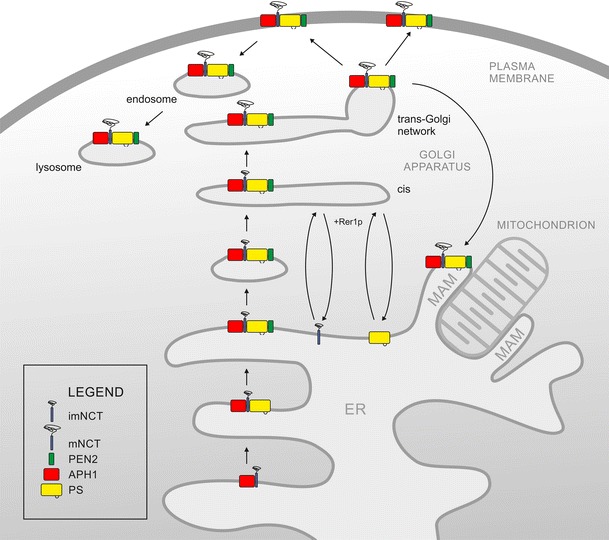
The four γ-secretase components are synthesized in the endoplasmic reticulum (ER), where the complex is gradually assembled.
Relevant Antibodies
| Catalog# | Product Name | Application | Reactivity |
|---|---|---|---|
| AMRe04092 | Nicastrin Rabbit Monoclonal Antibody | WB,IP | Human,Mouse,Rat |
| AMRe03142 | PEN2 Rabbit Monoclonal Antibody | WB,IHC-F,IHC-P,ICC/IF | Human,Mouse,Rat |
| AMRe05982 | Phospho-Presenilin 1 (Ser310) (16E10) Rabbit Monoclonal Antibody | WB | Human |
| AMRe01426 | Presenilin 2 Rabbit Monoclonal Antibody | WB,IP | Human,Mouse,Rat |
| APS0635 | HRP-conjugated Polyclonal Goat Anti-Rabbit IgG(H+L) Secondary Antibody | ELISA,WB,Dotblot | Mouse |
| AMRe80004 | GAPDH (12R9) Rabbit Monoclonal Antibody | WB,ELISA | Human,Mouse,Rat,Rabbit,Dog,Monkey |
Related Products
Super-sensitive ECL chemiluminescent reagent
References
- Hansson, C.A. et al. (2004) J Biol Chem 279, 51654-60.
- Haass, C. and De Strooper, B. (1999) Science 286, 916-9.
- Kimberly, W.T. et al. (2000) J Biol Chem 275, 3173-8.
- Kim, T.W. et al. (1997) J Biol Chem 272, 11006-10.
- Yu, G. et al. (2000) Nature 407, 48-54.
- Esler, W.P. et al. (2002) Proc Natl Acad Sci U S A 99, 2720-5.
- Kopan, R. and Goate, A. (2002) Neuron 33, 321-4.
- Chen, F. et al. (2001) Nat Cell Biol 3, 751-4.
- Sala Frigerio, C. et al. (2005) J Neurol 252, 1033-6.
- Steiner, H. et al. (2002) J Biol Chem 277, 39062-5.
- Smolarkiewicz M. et al. (2013) 250(5):997-1011.

Voisey
Voisey is a technical support specialist at EnkiLife, proficient in immunology and cell biology. She is committed to providing customers with professional and efficient technical support. Additionally, she is involved in research on customers' fields of study and designs highly cost-effective solutions for them.