
Procaspase Antibody
Apoptosis is a regulated physiological process leading to cell death. Caspases, a family of cysteine acid proteases, are central regulators of apoptosis. Initiator caspases (including 2, 8, 9, 10 and 12) are closely coupled to proapoptotic signals, which include the FasL, TNF-α, and DNA damage. Once activated, these caspases cleave and activate downstream effector caspases (including 3, 6 and 7), which in turn cleave cytoskeletal and nuclear proteins like PARP, α-fodrin, DFF and lamin A, and induce apoptosis.
Caspase-8 (FLICE, Mch5, MACH) and Caspase-9 (ICE-LAP6, Mch6) are initiator caspases. CD95 receptor (Fas/APO-1) and tumor necrosis factor receptor 1 (TNFR1) activate caspase-8, leading to the release of the caspase-8 active fragments, p18 and p10. Cytochrome c released from the mitochondria associates with procaspase-9 (47 kDa)/Apaf 1. Apaf-1 mediated activation of caspase-9 involves intrinsic proteolytic processing resulting in cleavage at Asp315 and producing a p35 subunit. Another cleavage occurs at Asp330 producing a p37 subunit that can serve to amplify the apoptotic response.
Caspase-3 (CPP-32, Apoptain, Yama, SCA-1), Caspase-6 (Mch2), and Caspase-7 (CMH-1, Mch3, ICE-LAP3) are effector caspases. Activation of caspase-3 requires proteolytic processing of its inactive zymogen/proform into activated p17 and p12 subunits. Procaspase-7 is activated through proteolytic processing by upstream caspases at Asp23, Asp198, and Asp206 to produce the mature subunits. Procaspase-6 is cleaved by caspase-3 at Asp23, Asp179 and Asp193 to form active large (p18) and small (p11) subunits.
PARP, a 116 kDa nuclear poly (ADP-ribose) polymerase, appears to be involved in DNA repair in response to environmental stress. This protein can be cleaved by many ICE-like caspases in vitro and is one of the main cleavage targets of caspase-3 in vivo. In human PARP, the cleavage occurs between Asp214 and Gly215, which separates the PARP amino-terminal DNA binding domain (24 kDa) from the carboxy-terminal catalytic domain (89 kDa). PARP helps cells to maintain their viability; cleavage of PARP facilitates cellular disassembly and serves as a marker of cells undergoing apoptosis.
Lamins are nuclear membrane structural components that are important in maintaining normal cell functions such as cell cycle control, DNA replication, and chromatin organization. Lamin A/C is cleaved by caspase-6 and serves as a marker for caspase-6 activation. During apoptosis, lamin A/C is specifically cleaved into large (41-50 kDa) and small (28 kDa) fragments. The cleavage of lamins results in nuclear disregulation and cell death.
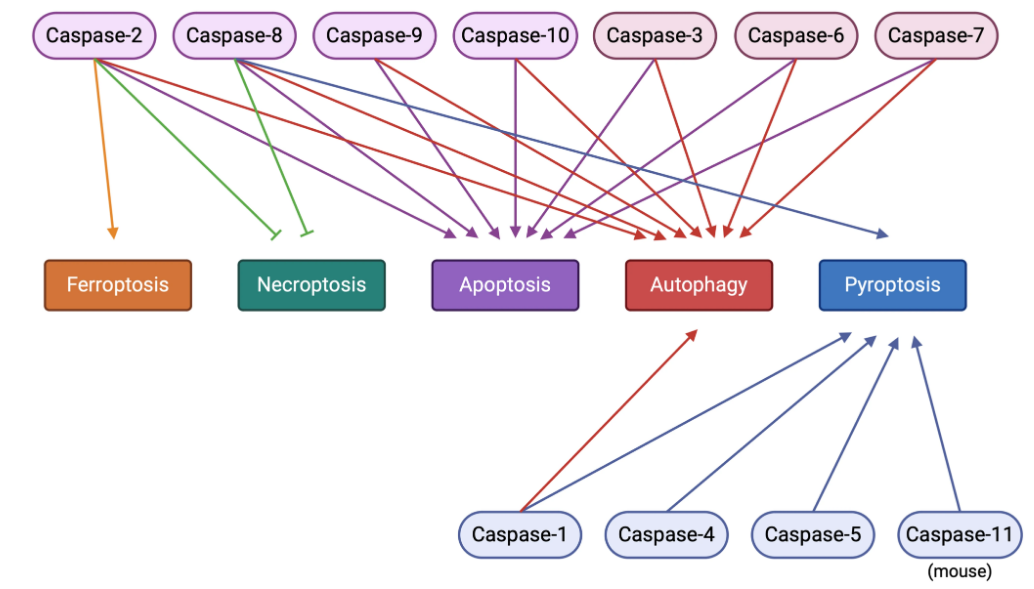

The role of caspases in programmed cell death
Relevant Antibodies
| Catalog# | Product Name | Application | Reactivity |
|---|---|---|---|
| AMRe85205 | Caspase 3 Rabbit Monoclonal Antibody | WB,IP,IHC,ICC | Human |
| AMRe03163 | Caspase 7 Rabbit Monoclonal Antibody | WB,IHC-P | Human |
| AMRe07983 | Caspase-8 (4D3) Rabbit Monoclonal Antibody | WB | Human |
| AMRe21545 | Caspase-9 Rabbit Monoclonal antibody | WB,IF,ELISA | Human,Mouse |
| AMRe21305 | Lamin A/C Rabbit Monoclonal antibody | WB,IHC,IF,IP,ELISA | Human,Mouse,Rat |
| AMRe02401 | PARP1 Rabbit Monoclonal Antibody | WB,IHC-F,IHC-P,ICC/IF | Human,Mouse,Rat |
| APS0635 | HRP-conjugated Polyclonal Goat Anti-Rabbit IgG(H+L) Secondary Antibody | ELISA,WB,Dotblot | Mouse |
| AMRe80004 | GAPDH (12R9) Rabbit Monoclonal Antibody | WB,ELISA | Human,Mouse,Rat,Rabbit,Dog,Monkey |
Related Products
- Antibody Labeling Kit
- Western Blot Kits
- Super-sensitive ECL chemiluminescent reagent
- IHC Kit
- TSA mIHC Kits
References
- Budihardjo, I. et al. (1999) Annu Rev Cell Dev Biol 15, 269-90.
- Cohen, G.M. (1997) Biochem J 326 ( Pt 1), 1-16.
- Muzio, M. et al. (1996) Cell 85, 817-27.
- Boldin, M.P. et al. (1996) Cell 85, 803-15.
- Fernandes-Alnemri, T. et al. (1996) Proc Natl Acad Sci U S A 93, 7464-9.
- Duan, H. et al. (1996) J Biol Chem 271, 16720-4.
- Srinivasula, S.M. et al. (1996) J Biol Chem 271, 27099-106.
- Liu, X. et al. (1996) Cell 86, 147-57.
- Li, P. et al. (1997) Cell 91, 479-89.
- Zou, H. et al. (1999) J Biol Chem 274, 11549-56.
- Srinivasula, S.M. et al. (1998) Mol Cell 1, 949-57.
- Fernandes-Alnemri, T. et al. (1994) J Biol Chem 269, 30761-4.
- Faleiro, L. et al. (1997) EMBO J 16, 2271-81.
- Fernandes-Alnemri, T. et al. (1995) Cancer Res 55, 6045-52.
- Duan, H. et al. (1996) J Biol Chem 271, 1621-5.
- Lippke, J.A. et al. (1996) J Biol Chem 271, 1825-8.
- Nicholson, D.W. et al. (1995) Nature 376, 37-43.
- Satoh, M.S. and Lindahl, T. (1992) Nature 356, 356-8.
- Lazebnik, Y.A. et al. (1994) Nature 371, 346-7.
- Tewari, M. et al. (1995) Cell 81, 801-9.
- Oliver, F.J. et al. (1998) J Biol Chem 273, 33533-9.
- Gruenbaum, Y. et al. (2000) J Struct Biol 129, 313-23.
- Yabuki, M. et al. (1999) Physiol Chem Phys Med NMR 31, 77-84.
- Goldberg, M. et al. (1999) Crit Rev Eukaryot Gene Expr 9, 285-93.
- Orth, K. et al. (1996) J Biol Chem 271, 16443-6.
- Oberhammer, F.A. et al. (1994) J Cell Biol 126, 827-37.
- Rao, L. et al. (1996) J Cell Biol 135, 1441-55.
- Abdelghany L. et al. (2024) Cell Mol Life Sci. 81(1):474.
 | Voisey Voisey is a technical support specialist at EnkiLife, proficient in immunology and cell biology. She is committed to providing customers with professional and efficient technical support. Additionally, she is involved in research on customers' fields of study and designs highly cost-effective solutions for them. |