
Pro-Survival Bcl-2 Family Antibody
The Bcl-2 family consists of a number of evolutionarily conserved proteins containing Bcl-2 homology domains (BH) that regulate apoptosis through control of mitochondrial membrane permeability and release of cytochrome c. Four BH domains have been identified (BH1-4) that mediate protein interactions. The family can be separated into three groups based upon function and sequence homology: pro-survival members include Bcl-2, Bcl-xL, Mcl-1, A1 and Bcl-w; pro-apoptotic proteins include Bax, Bak and Bok; and "BH3 only" proteins Bad, Bik, Bid, Puma, Bim, Bmf, Noxa and Hrk. Interactions between death-promoting and death-suppressing Bcl-2 family members has led to a rheostat model in which the ratio of pro-apoptotic and anti-apoptotic proteins controls cell fate. Thus, pro-survival members exert their behavior by binding to and antagonizing death-promoting members. In general, the "BH3-only members" can bind to and antagonize the pro-survival proteins leading to increased apoptosis. While some redundancy of this system likely exists, tissue specificity, transcriptional and post-translational regulation of many of these family members can account for distinct physiological roles.
Several phosphorylation sites have been identified within Bcl-2 including Thr56, Ser70, Thr74 and Ser87. These phosphorylation sites may be targets of the ASK1/MKK7/JNK1 pathway, and phosphorylation of Bcl-2 may be a marker for mitotic events. Mutation of Bcl-2 at Thr56 or Ser87 inhibits its anti-apoptotic activity during glucocorticoid-induced apoptosis of T lymphocytes. Interleukin 3 and JNK-induced Bcl-2 phosphorylation at Ser70 may be required for its enhanced antiapoptotic functions.
Mcl-1 is phosphorylated in response to treatment with phorbol ester, microtubule-damaging agents, oxidative stress, and cytokine withdrawal. Phosphorylation at Thr163, the conserved MAP kinase/ERK site located within the PEST region, slows Mcl-1 protein turnover but may prime the GSK-3 mediated phosphorylation at Ser159 that leads to Mcl-1 destabilization.
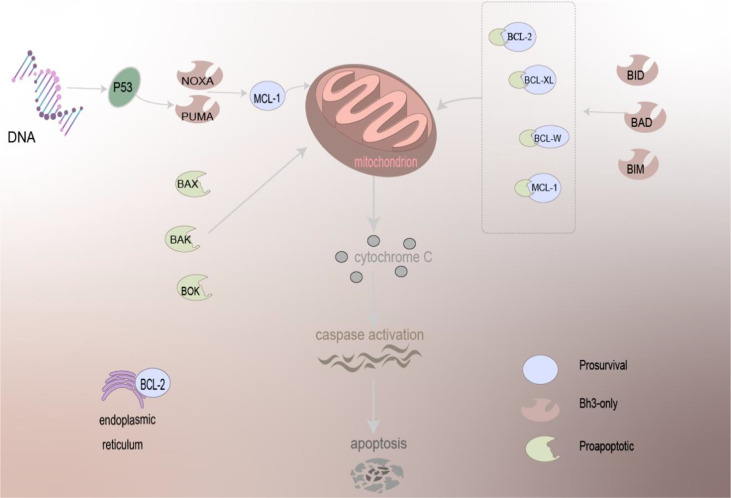

The mechanism of BCL-2 family proteins in regulating apoptosis
Relevant Antibodies
| Catalog# | Product Name | Application | Reactivity |
|---|---|---|---|
| APRab04303 | Bcl-2 (phospho Ser70) Rabbit Polyclonal Antibody | WB,IHC-P,IF-P,IF-F,ICC/IF,IP,ELISA | Human,Monkey |
| AMRe21374 | Bcl-2 Rabbit Monoclonal antibody | WB,IHC,IF,IP,ELISA | Human,Mouse,Rat |
| AMRe21520 | Bcl-XL Rabbit Monoclonal antibody | WB,IHC,IF,IP,ELISA | Human,Mouse,Rat |
| AMRe13712 | MCL1 (18O13) Rabbit Monoclonal Antibody | WB,IHC-P,ICC/IF,FC,IP,IF-P | Human,Mouse,Rat |
| APS0635 | HRP-conjugated Polyclonal Goat Anti-Rabbit IgG(H+L) Secondary Antibody | ELISA,WB,Dotblot | Mouse |
| AMRe80004 | GAPDH (12R9) Rabbit Monoclonal Antibody | WB,ELISA | Human,Mouse,Rat,Rabbit,Dog,Monkey |
Related Products
- Antibody Labeling Kit
- Western Blot Kits
- Super-sensitive ECL chemiluminescent reagent
- IHC Kit
- TSA mIHC Kits
References
- Cory, S. et al. (2003) Oncogene 22, 8590-607.
- Antonsson, B. and Martinou, J.C. (2000) Exp Cell Res 256, 50-7.
- Sharpe, J.C. et al. (2004) Biochim Biophys Acta 1644, 107-13.
- Korsmeyer, S.J. et al. (1993) Semin Cancer Biol 4, 327-32.
- Bouillet, P. and Strasser, A. (2002) J Cell Sci 115, 1567-74.
- Maundrell, K. et al. (1997) J Biol Chem 272, 25238-42.
- Yamamoto, K. et al. (1999) Mol Cell Biol 19, 8469-78.
- Ling, Y.H. et al. (1998) J Biol Chem 273, 18984-91.
- Huang, S.T. and Cidlowski, J.A. (2002) FASEB J 16, 825-32.
- Deng, X. et al. (2001) J Biol Chem 276, 23681-8.
- Domina, A.M. et al. (2000) J Biol Chem 275, 21688-94.
- Inoshita, S. et al. (2002) J Biol Chem 277, 43730-4.
- Domina, A.M. et al. (2004) Oncogene 23, 5301-15.
- Maurer, U. et al. (2006) Mol Cell 21, 749-60.
- Qian S. et al. (2022) Front Oncol, 12:985363.
 | Voisey Voisey is a technical support specialist at EnkiLife, proficient in immunology and cell biology. She is committed to providing customers with professional and efficient technical support. Additionally, she is involved in research on customers' fields of study and designs highly cost-effective solutions for them. |