
E-cadherin is considered an active suppressor of invasion and growth of many epithelial cancers. Recent studies indicate that cancer cells have upregulated N-cadherin in addition to loss of E-cadherin. This change in cadherin expression is called the "cadherin switch" and downregulation of E-cadherin is one of the hallmarks of EMT.
Vimentin is an intermediate filament of mesenchymal origin and is present at early developmental stages. Vimentin's dynamic structural changes and spatial re-organization in response to extracellular stimuli helps to coordinate various signaling pathways.
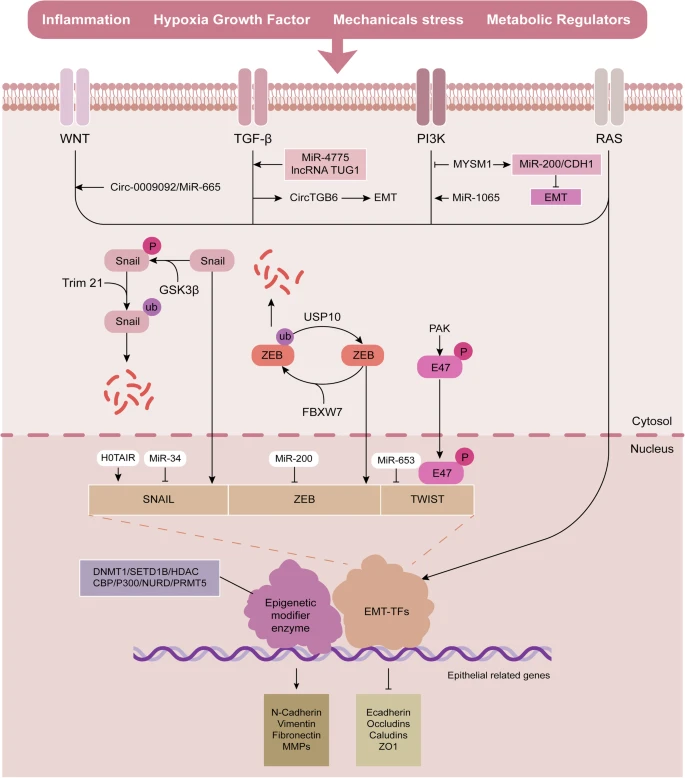
EMT is regulated by a complex network involving transcriptional regulation, post-translational modifications, epigenetic modifications, non-coding RNAs, and signaling pathways.
| Catalog# | Product Name | Application | Reactivity |
|---|---|---|---|
| AMRe21480 | Claudin 1 Rabbit Monoclonal antibody | WB,IHC,IF,IP,ELISA | Human,Mouse,Rat |
| AMRe01411 | E Cadherin Rabbit Monoclonal Antibody | WB,IHC-F,IHC-P,ICC/IF,IP | Human |
| AMRe21484 | N Cadherin Rabbit Monoclonal antibody | WB,IHC,IF,IP,ELISA | Human,Mouse,Rat |
| AMM81417 | SNAI2 Mouse Monoclonal Antibody | WB,IHC,ICC,FC,ELISA | Human |
| AMM81225 | TWIST1 Mouse Monoclonal Antibody | WB,IHC,ICC,FC,ELISA | Human,Mouse,Rat,Rabbit |
| AMRe21330 | Vimentin Rabbit Monoclonal antibody | WB,IHC,IF,IP,ELISA | Human,Mouse,Rat |
| AMRe21526 | AREB6 Rabbit Monoclonal antibody | WB,IHC,IF,IP,ELISA | Human,Rat |
| AMRe21195 | ZO1 Rabbit Monoclonal antibody | WB,IHC,IF,IP,ELISA | Human,Mouse,Rat |
- Antibody Labeling Kit
- Western Blot Kits
- Super-sensitive ECL chemiluminescent reagent
- IHC Kit
- TSA mIHC Kits
- Aigner, K. et al. (2007) Oncogene 26, 6979-88.
- Peinado, H. et al. (2007) Nat Rev Cancer 7, 415-28.
- Moreno-Bueno, G. et al. (2008) Oncogene 27, 6958-69.
- Wheelock, M.J. and Johnson, K.R. (2003) Annu Rev Cell Dev Biol 19, 207-35.
- Christofori, G. (2003) EMBO J 22, 2318-23.
- Hazan, R.B. et al. (2004) Ann N Y Acad Sci 1014, 155-63.
- Shin, K. et al. (2006) Annu Rev Cell Dev Biol 22, 207-35.
- Oliveira, S.S. and Morgado-Díaz, J.A. (2007) Cell Mol Life Sci 64, 17-28.
- Matter, K. and Balda, M.S. (2007) J Cell Sci 120, 1505-11.
- Hernandez, S. et al. (2007) Exp Cell Res 313, 1533-47.
- Umeda, K. et al. (2006) Cell 126, 741-54.
- Reichert, M. et al. (2000) J Biol Chem 275, 9492-500.
- Helfand, B.T. et al. (2004) J Cell Sci 117, 133-41.
- Inukai, T. et al. (1999) Mol Cell 4, 343-52.
- Barrallo-Gimeno, A. and Nieto, M.A. (2005) Development 132, 3151-61.
- Bolós, V. et al. (2003) J Cell Sci 116, 499-511.
- Turner, F.E. et al. (2006) J Biol Chem 281, 21321-31.
- Lee, M.S. et al. (1999) J Cell Biochem 75, 566-77.
- Chen, Z.F. and Behringer, R.R. (1995) Genes Dev 9, 686-99.
- Yang, J. et al. (2004) Cell 117, 927-39.
- Watanabe, O. et al. (2005) Anticancer Res 24, 3851-6.
 | Voisey Voisey is a technical support specialist at EnkiLife, proficient in immunology and cell biology. She is committed to providing customers with professional and efficient technical support. Additionally, she is involved in research on customers' fields of study and designs highly cost-effective solutions for them. |