
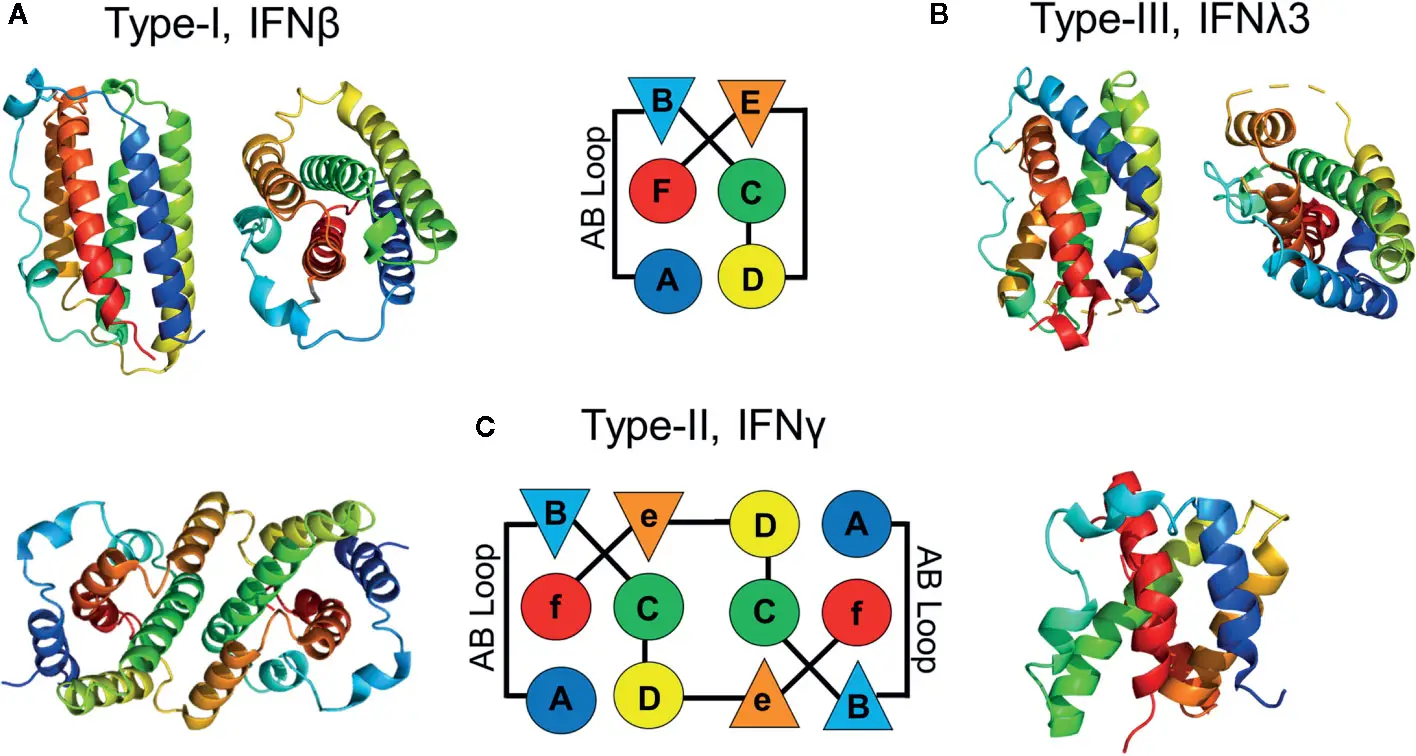
 Originally discovered in the late 1950s for their antiviral activity, interferons (IFNs) have since been assigned diverse roles in many physiological and pathological processes. There are three families of IFNs: types I, II, and III. In humans, type I contains IFN-α (13 different subtypes), IFN-β (also known as IFN-β1), IFN-ε, IFN-κ, and IFN-ω. They bind to a receptor complex containing IFNAR1 and IFNAR2, which is broadly expressed on most cells. IFN-γ is the sole member of type II IFN. It signals through a receptor complex consisting of IFNγR1 and IFNγR2, which is also expressed on most cell types. Type III IFN, also known as interferon lambdas (IFN-λs), has four members in humans: IFN-λ1 (IL29), IFN-λ2 (IL28A), IFN-λ3 (IL28B), and IFN-λ4. IFN-λs signal through a heterodimeric receptor composed of IFNλR1 and IL-10R2. While IL-10R2 is broadly expressed and shared by the IL-10 family cytokines, IFNλR1 expression is restricted to epithelial cells, neuronal cells, and subsets of myeloid cells. Engagement of all IFNs with their receptors initiates downstream signaling events, mainly activation of the Jak/Stat signaling cascade. For type I and III IFNs, Jak1 and Tyk2 are phosphorylated and activated, leading to subsequent phosphorylation of Stat1 and Stat2. Phosphorylated Stat1 and Stat2 are released from the receptor complex. They, along with IRF-9, form the so-called interferon-stimulated gene factor 3 (ISGF3) transcriptional complex. ISGF3 translocates to the nucleus, binds to the interferon-stimulated response element (ISRE) to initiate the transcription of a wide array of interferon-stimulated genes (ISGs). On the other hand, IFN-γ induces phosphorylation and activation of Jak1 and Jak2, which subsequently phosphorylate Stat1. Phosphorylated Stat1 dimerizes, translocates to the nucleus, and binds to γ-interferon-activated site (GAS) to initiate the transcription of ISGs.
Product List
| Target | Catalog# | Product Name | Reactivity | Application |
|---|---|---|---|---|
Tyk 2 | APRab19465 | Tyk 2 Rabbit Polyclonal Antibody | Human,Mouse,Monkey | WB,IHC-P,IF-P,IF-F,ICC/IF,ELISA |
Related Products
Super-sensitive ECL chemiluminescent reagent
References
- Interferon-stimulated genes: a complex web of host defenses. Schneider WM, et al. Annu Rev Immunol. 2014. [PMID: 24555472]
- The I kappa B proteins: multifunctional regulators of Rel/NF-kappa B transcription factors. Beg AA, et al. Genes Dev. 1993. [PMID: 8224838]
- Interferon Lambda Genetics and Biology in Regulation of Viral Control. Hemann EA, et al. Front Immunol. 2017. [PMID: 29270173]
- The Role of Structure in the Biology of Interferon Signaling. Walter MR. Front Immunol. 2020. [PMID: 33281831]
- Direct effects of type I interferons on cells of the immune system. Hervas-Stubbs S, et al. Clin Cancer Res. 2011. [PMID: 21372217]
- Decoding type I and III interferon signalling during viral infection. Mesev EV, et al. Nat Microbiol. 2019. [PMID: 30936491]
- Current prospects of type II interferon γ signaling and autoimmunity. Green DS, et al. J Biol Chem. 2017. [PMID: 28652404]
- IFNγ: signalling, epigenetics and roles in immunity, metabolism, disease and cancer immunotherapy. Ivashkiv LB. Nat Rev Immunol. 2018. [PMID: 29921905]