
Human Reactive Inflammatory Cytokine Antibody
Interleukin-1 alpha (IL-1α) and interleukin-1 beta (IL-1β) are pro-inflammatory cytokines (1). IL-1α is produced by many cell types, including epithelial cells, monocytes, and macrophages (1,2). It is typically sequestered but can be released during necroptosis or inflammasome activation (3-5). IL-1α is active in both its uncleaved (pro-IL-1α) and cleaved forms and thus acts as an alarmin, initiating signaling through IL-1R1 (6). IL-1β is not active until it is cleaved (7,8). IL-1β expression is induced by inflammatory stimuli, including TLR ligands, IL-1β itself, and tumor necrosis factor-alpha (TNF-α) (1,9,10). IL-1β is primarily synthesized by activated monocytes and macrophages. It activates innate immune cells and polarizes CD4+ T cells toward T helper (Th) 1 and Th17 cells (10).
IL-2 is mainly produced by activated CD4+ and CD8+ T cells (11). IL-2 is a pro-inflammatory cytokine, promoting proliferation and activation of CD4+ and CD8+ T cells, B cells, and NK cells through binding the IL-2 receptor complex (11). At low doses, however, IL-2 can have anti-inflammatory effects (12).
IL-4, a cytokine produced by mast cells, basophils, and activated T cells, is an anti-inflammatory cytokine that promotes differentiation of naive T cells into Th2 lineage cells (13-15). In autoimmune conditions, IL-4 can play pro-inflammatory roles and is a therapeutic target (16).
IL-6, when interacting with soluble IL-6R and binding to gp130, has pro-inflammatory effects, but when interacting with membrane-bound IL-6R, it exerts anti-inflammatory effects (17). IL-6 regulates the acute phase response and is produced by T cells, macrophages, and endothelial cells (18,19). IL-6 can also prime macrophages for M2, or anti-inflammatory, states by upregulating IL-4R (20).
IL-8 is a neutrophil chemoattractant and is able to activate degranulation and respiratory burst (21-23). IL-8 is produced by T cells, monocytes, neutrophils, fibroblasts, endothelial cells, and others in response to inflammatory stimuli such as IL-1α/β and TNF-α (24). Beyond its chemotactic effects, IL-8 can play roles in cancer by promoting tumor angiogenesis and stimulating proliferation by activating NF-kB signaling (25,26).
IL-10 is an anti-inflammatory cytokine produced by various immune cells (27,28). IL-10 is often produced alongside pro-inflammatory cytokines in response to pathogens and limits damage to the host that can be caused by strong inflammatory responses (29). After binding to IL-10Rα, which complexes with IL-10Rβ, IL-10 activates Stat3, suppresses gp130 activity, and induces expression of transcriptional repressors of the inflammatory response (30).
Interferon-gamma (IFN-γ) is produced by T, B, NK, and antigen-presenting cells and has diverse pro- and anti-inflammatory functions (31). Its expression is induced by type I IFNs, IL-12, IL-15, and IL-18, and it acts through IFNγR1 and IFNγR2 to activate signaling through Stat1 (31). IFN-γ upregulates expression of major histocompatibility complex (MHC) class I and II, which help to activate cytotoxic CD8+ and CD4+ T cells, respectively (31-33). IFN-γ can also suppress pro-inflammatory cytokine expression and promote tumor cell apoptosis by upregulating expression of several caspases (31,34).
TNF-α is a pro-inflammatory mediator secreted by various subsets of immune cells, including T cells, B cells, NK cells, and macrophages (35). In the context of certain autoimmune diseases, and in antigen presentation, however, TNF-α can be immunosuppressive (36,37). TNF-α expression is induced by various stimuli, including IL-1β, IFN-γ, and microbial infections. Depending on downstream signaling checkpoints through MAPK, NF-kB, and caspase-8, it can promote both inflammatory gene expression and apoptosis, necroptosis, and pyroptosis (38-41).
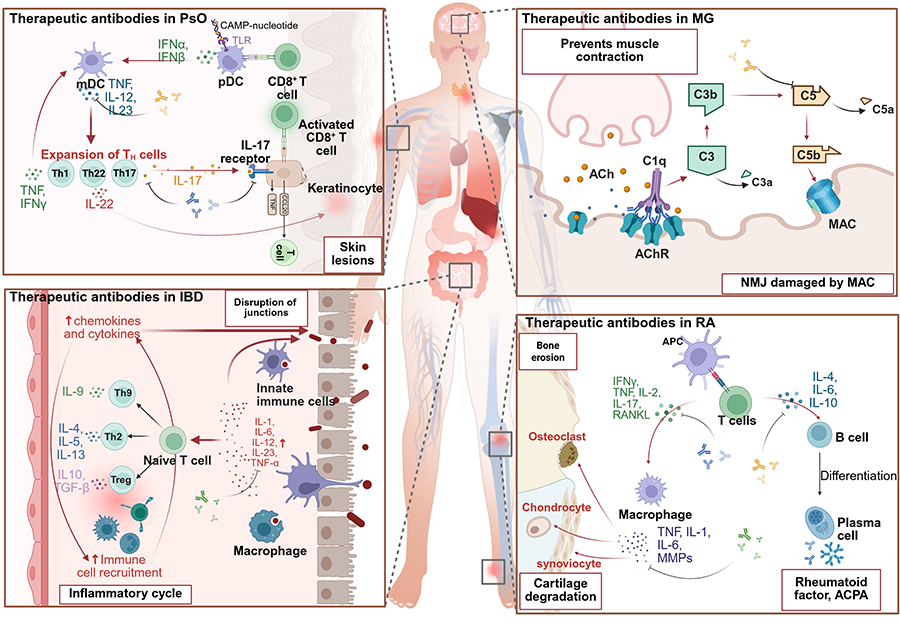
Relevant Antibodies
| Catalog# | Product Name | Application | Reactivity |
|---|---|---|---|
| AMM82630 | IL1A Mouse Monoclonal Antibody | ICC,FC,ELISA | Human |
| AMRe21130 | IL-1 β Rabbit Monoclonal antibody | WB,IF,IP,ELISA | Human,Mouse,Rat |
| AMM80713 | IL-2 Mouse Monoclonal Antibody | WB,ICC,ELISA | Human,Mouse,Rat |
| AMRe01428 | IL-4 Rabbit Monoclonal Antibody | WB | Human |
| AMM20469 | IL-6 Mouse Monoclonal Antibody | IF-P,IF-F,IF-ICC,IHC-P,IHC-F,WB | Human |
| AMRe12568 | IL8 (6Z6) Rabbit Monoclonal Antibody | WB | Human |
| AMRe21258 | IL-10 Rabbit Monoclonal antibody | WB,IF,IP,ELISA | Human,Mouse,Rat |
| AMRe12684 | Interferon gamma (16O15) Rabbit Monoclonal Antibody | IHC-P,IF-P | Human |
| AMRe21365 | TNF α Rabbit Monoclonal antibody | WB,IHC,IF,IP,ELISA | Human,Mouse,Rat |
| APS0635 | HRP-conjugated Polyclonal Goat Anti-Rabbit IgG(H+L) Secondary Antibody | ELISA,WB,Dotblot | Mouse |
| APS0631 | HRP-conjugated Polyclonal Goat Anti-Mouse IgG(H+L) Secondary Antibody | ELISA,WB,Dotblot | Mouse |
| AMRe80004 | GAPDH (12R9) Rabbit Monoclonal Antibody | WB,ELISA | Human,Mouse,Rat,Rabbit,Dog,Monkey |
Related Products
Super-sensitive ECL chemiluminescent reagent
References
- Garlanda, C. et al. (2013) Immunity 39, 1003-18.
- Palomo, J. et al. (2015) Cytokine 76, 25-37.
- Dinarello, C.A. (2018) Immunol Rev 281, 8-27.
- Cohen, I. et al. (2010) Proc Natl Acad Sci USA 107, 2574-9.
- Tsuchiya, K. et al. (2021) Cell Rep 34, 108887.
- Malik, A. and Kanneganti, T.D. (2018) Immunol Rev 281, 124-137.
- Thornberry, N.A. et al. (1992) Nature 356, 768-74.
- Cerretti, D.P. et al. (1992) Science 256, 97-100.
- Dinarello, C.A. (2011) Blood 117, 3720-32.
- Bent, R. et al. (2018) Int J Mol Sci 19, 2155.
- Liao, W. et al. (2011) Curr Opin Immunol 23, 598-604.
- Zhang, J.Y. et al. (2022) Nat Commun 13, 7324.
- Yokota, T. et al. (1986) Proc Natl Acad Sci USA 83, 5894-8.
- Grabstein, K. et al. (1986) J Exp Med 163, 1405-14.
- Kopf, M. et al. (1993) Nature 362, 245-8.
- Gärtner, Y. et al. (2023) Pharmacol Ther 242, 108348.
- Scheller, J. et al. (2011) Biochim Biophys Acta 1813, 878-88.
- Heinrich, P.C. et al. (1998) Biochem J 334 (Pt 2), 297-314.
- Heinrich, P.C. et al. (1998) Z Ernahrungswiss 37 Suppl 1, 43-9.
- Mauer, J. et al. (2014) Nat Immunol 15, 423-30.
- Payne, A.S. and Cornelius, L.A. (2002) J Invest Dermatol 118, 915-22.
- Brat, D.J. et al. (2005) Neuro Oncol 7, 122-33.
- Mukaida, N. (2003) Am J Physiol Lung Cell Mol Physiol 284, L566-77.
- Baggiolini, M. and Clark-Lewis, I. (1992) FEBS Lett 307, 97-101.
- Zhang, B. et al. (2015) Cancer Biol Ther 16, 898-911.
- Fousek, K. et al. (2021) Pharmacol Ther 219, 107692.
- Moore, K.W. et al. (2001) Annu Rev Immunol 19, 683-765.
- Gabryšová, L. et al. (2014) Curr Top Microbiol Immunol 380, 157-90.
- Saraiva, M. and O'Garra, A. (2010) Nat Rev Immunol 10, 170-81.
- Saraiva, M. et al. (2020) J Exp Med 217, e20190418.
- Castro, F. et al. (2018) Front Immunol 9, 847.
- Curtsinger, J.M. et al. (2012) J Immunol 189, 659-68.
- Akbar, S.M. et al. (1996) Immunology 87, 519-27.
- Mühl, H. and Pfeilschifter, J. (2003) Int Immunopharmacol 3, 1247-55.
- Aggarwal, B.B. (2003) Nat Rev Immunol 3, 745-56.
- Kassiotis, G. and Kollias, G. (2001) J Exp Med 193, 427-34.
- Masli, S. and Turpie, B. (2009) Immunology 127, 62-72.
- Bethea, J.R. et al. (1992) J Neuroimmunol 36, 179-91.
- Vila-del Sol, V. et al. (2008) J Immunol 181, 4461-70.
- Rahman, M.M. and McFadden, G. (2006) PLoS Pathog 2, e4.
van Loo, G. and Bertrand, M.J.M. (2023) Nat Rev Immunol 23, 289-303.
Lai Y.et al.(2016) Int Immunol 28(4):181-8.
Liang J.et al.(2025)Health and Metabolis,2 (4), 8.
 | Voisey Voisey is a technical support specialist at EnkiLife, proficient in immunology and cell biology. She is committed to providing customers with professional and efficient technical support. Additionally, she is involved in research on customers' fields of study and designs highly cost-effective solutions for them. |