
Double Strand Breaks (DSB) Repair
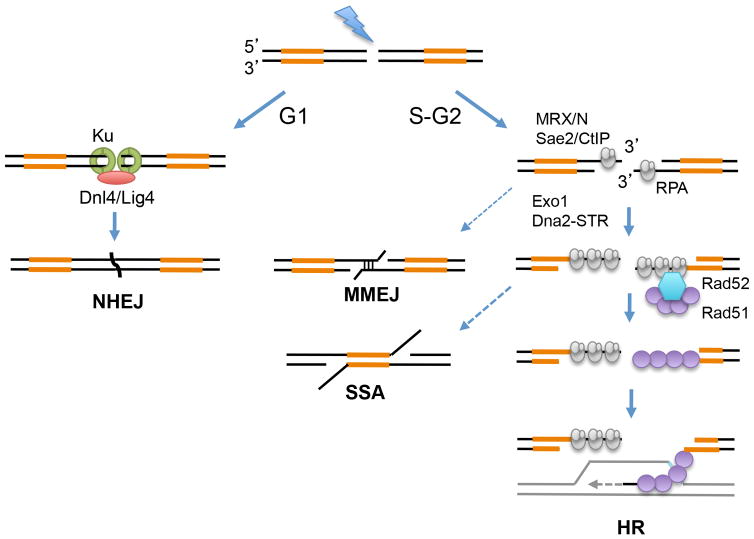
DNA double-strand breaks (DSBs) can form as a consequence of normal cell metabolism or by action of exogenous agents, such as ionizing radiation (IR) or chemotherapeutic drugs. Typically, DSBs are repaired by an end joining mechanism or by homologous recombination (HR). Non-homologous end joining (NHEJ) involves the direct ligation of DNA ends with little or no homology and is generally considered to be an error-prone process because nucleotides can be lost or gained at the ends prior to ligation. One form of alt-NHEJ involves alignment of ends through very short sequence homologies (generally<18 nt) internal to the ends that are revealed by end resection and is termed microhomology-mediated end joining (MMEJ). If long (>200 bp) direct repeats flank the DSB, then repair can occur by annealing of the complementary 3′-ssDNA tails formed by end resection in a mechanism referred to as single-strand annealing (SSA). In several respects SSA and MMEJ are similar, they differ by the extent of sequence homology and requirement for a dedicated annealing protein for SSA (Rad52) resulting in a higher efficiency of repair than MMEJ. HR requires a homologous DNA duplex as a template for repair of the broken chromosome, and consequently HR is restricted to the S and G2 phases of the cell cycle when a sister chromatid is present and kept in close proximity by Cohesin.
Product List
| Target | Catalog# | Product Name | Reactivity | Application |
|---|---|---|---|---|
Phospho-ATM (S1981) (3F17) | Phospho-ATM (S1981) (3F17) Rabbit Monoclonal Antibody | Human | WB,IHC-P,FC,IP,IF-P |
Related Products
Super-sensitive ECL chemiluminescent reagent
References
- Mechanism and regulation of DNA end resection in eukaryotes. Symington LS. Crit Rev Biochem Mol Biol. 2016. [PMID: 27098756]
- Diseases associated with defective responses to DNA damage. O'Driscoll M. Cold Spring Harb Perspect Biol. 2012. [PMID: 23209155]
- Repair of double-strand breaks by end joining. Chiruvella KK, et al. Cold Spring Harb Perspect Biol. 2013. [PMID: 23637284]
- Microhomology-Mediated End Joining: A Back-up Survival Mechanism or Dedicated Pathway? Sfeir A, et al. Trends Biochem Sci. 2015. [PMID: 26439531]
- Multiple pathways of recombination induced by double-strand breaks in Saccharomyces cerevisiae. Pâques F, et al. Microbiol Mol Biol Rev.1999. [PMID: 10357855]
- Double-strand break end resection and repair pathway choice. Symington LS, et al. Annu Rev Genet. 2011. [PMID: 21910633]