Size1:40µg Price1:$120
Size2:200µg Price2:$180
Size3:2mg Price3:$360
Product Overview
The EnkiLife FITC Labeling Kit contains multiple components for labeling antibody proteins, such as high-performance fluorescent dye, purification ultrafiltration tubes, elution labeling buffer, and labeled protein storage solution. It enables easy and reliable labeling of antibodies, proteins, and other molecules for use as fluorescent probes.
Product Features
- Fast: Labeling reaction takes only about 30 minutes, balancing both labeling efficiency and effectiveness.
- Simple: Each dye reagent is pre-optimized for the corresponding antibody amount, eliminating tedious calculations. Follow the steps to achieve excellent results.
- Flexible: Dyes in large sizes kits can be aliquoted with consistent batch performance, convenient for multiple uses.
- Excellent Labeling: Optimized labeling buffer enables relatively fixed labeling sites, enhancing the homogeneity of labeled antibodies.
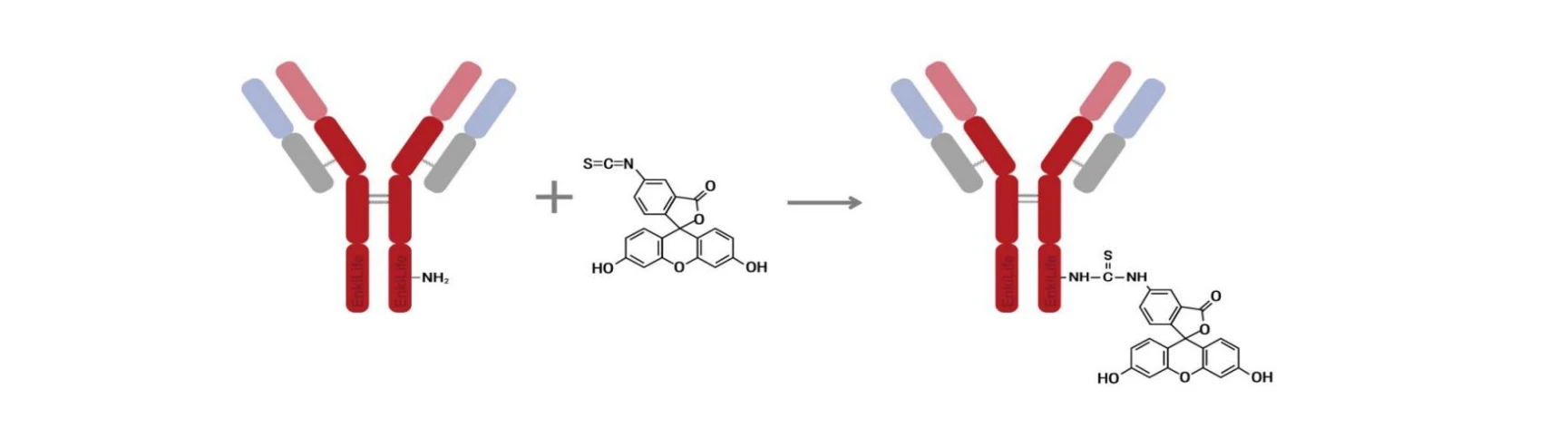
- Amine-Specific Labeling: The reactive group on FITC efficiently binds to primary amine groups on antibodies or other purified proteins, achieving covalent labeling.
- Protein Labeling: Primarily designed for IgG antibodies, but can also label proteins of similar size and properties to IgG.
Dye Introduction
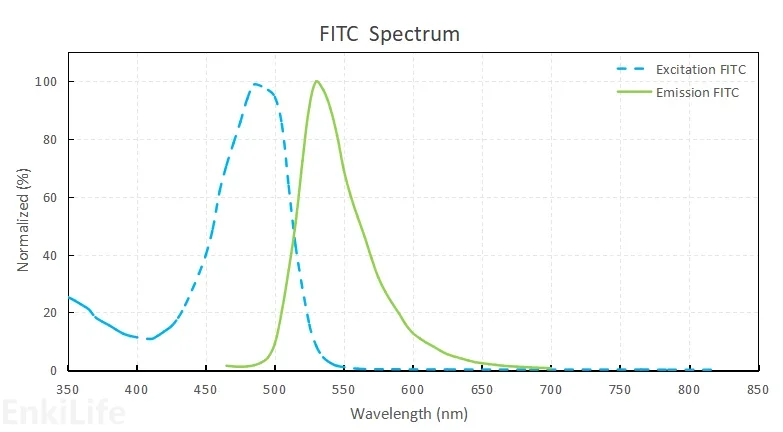
FITC is a classic fluorescent dye with extensive applications, commonly used in flow cytometry, immunofluorescence, and other techniques. It exists in two isomeric forms, 5'-FITC and 6'-FITC, and is typically used as a mixture for protein labeling. Fluorescein offers numerous advantages: it possesses an excellent quantum yield, reaching up to 0.94, resulting in very high initial brightness; its excitation maximum is at 495 nm, which aligns well with the commonly used 488 nm laser line (argon-ion laser). Its weaknesses include relatively poor photostability, as fluorescence is prone to quenching under prolonged illumination, and its fluorescence is pH-sensitive, diminishing under acidic conditions.
Dye Properties
Basic Characteristics
Similar Dyes:ATTO 488, Alexa Fluor® 488, Spark Blue™ 515 Cy®2, DyLight® 488,FAM, Fluorescein-X
Common Excitation Sources: 488 nm
Maximum Excitation Wavelength: 495nm
Maximum Emission Wavelength: 520nm
Molar Extinction Coefficient: 68000L/(mol·cm)
Quantum Yield:0.92
Appearance:Yellow solid
Kit Specifications
| Product Components | Component Content in Different Specifications | Storage Temperature | ||
|---|---|---|---|---|
| 40μg Antibody | 200μg Antibody | 2mg Antibody | ||
| Activated Dye | 1 tube | 5 tubes | 5 tubes | -20°C after opening, protected from light |
| 50KDa Ultrafiltration Tube* | 1 set** | 1 set** | 1 set** | RT |
| Labeling Buffer S | 10 mL | 10 mL | 10 mL | 2~8°C |
| 1×PBS (pH 7.4) | 10 mL | 10 mL | 10 mL | 2~8°C |
| DMF | 100 μL | 100 μL | 100 μL | 2~8°C, protected from light |
| Labeled Protein Storage Solution | 200 μL | 1 mL | 5 mL | 2~8°C |
| Recommended Labeling Amount | Each tube dyes for labeling 20-40μg antibody Recommended: 20μg antibody | Each tube dyes for labeling 20-40μg antibody Recommended: 20μg antibody | Each tube dyes for labeling 100-400μg antibody Recommended: 200μg antibody | |
* Ultrafiltration tube molecular weight cutoff: 50KDa
** 1 set = 1 ultrafiltration tube and collection tube
Labeling Principle
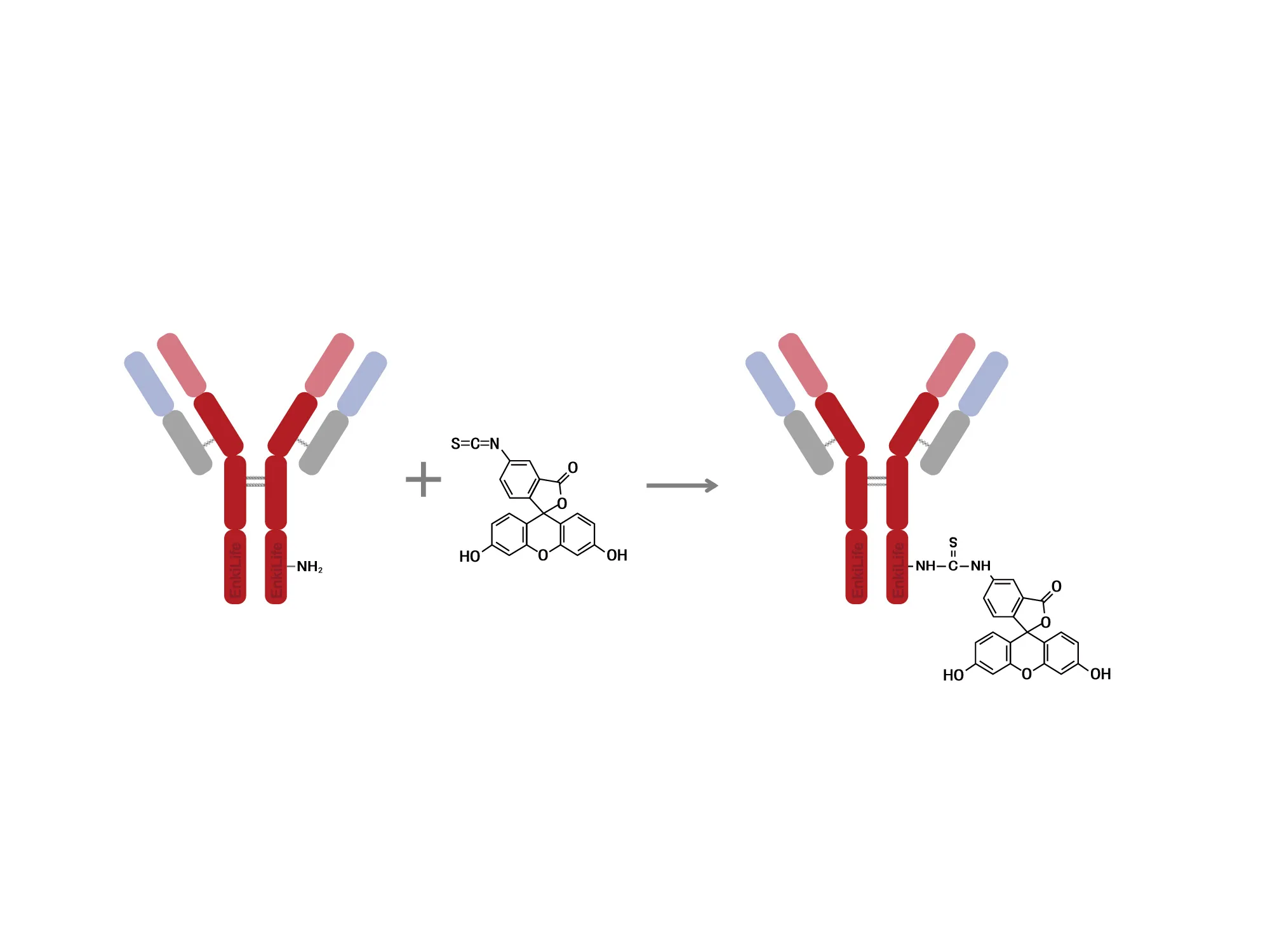
Under specific chemical reaction conditions, the fluorescent dye activation group specifically reacts with primary amine groups on antibody proteins, forming stable amide bonds, thereby achieving labeling conjugation with antibody proteins.
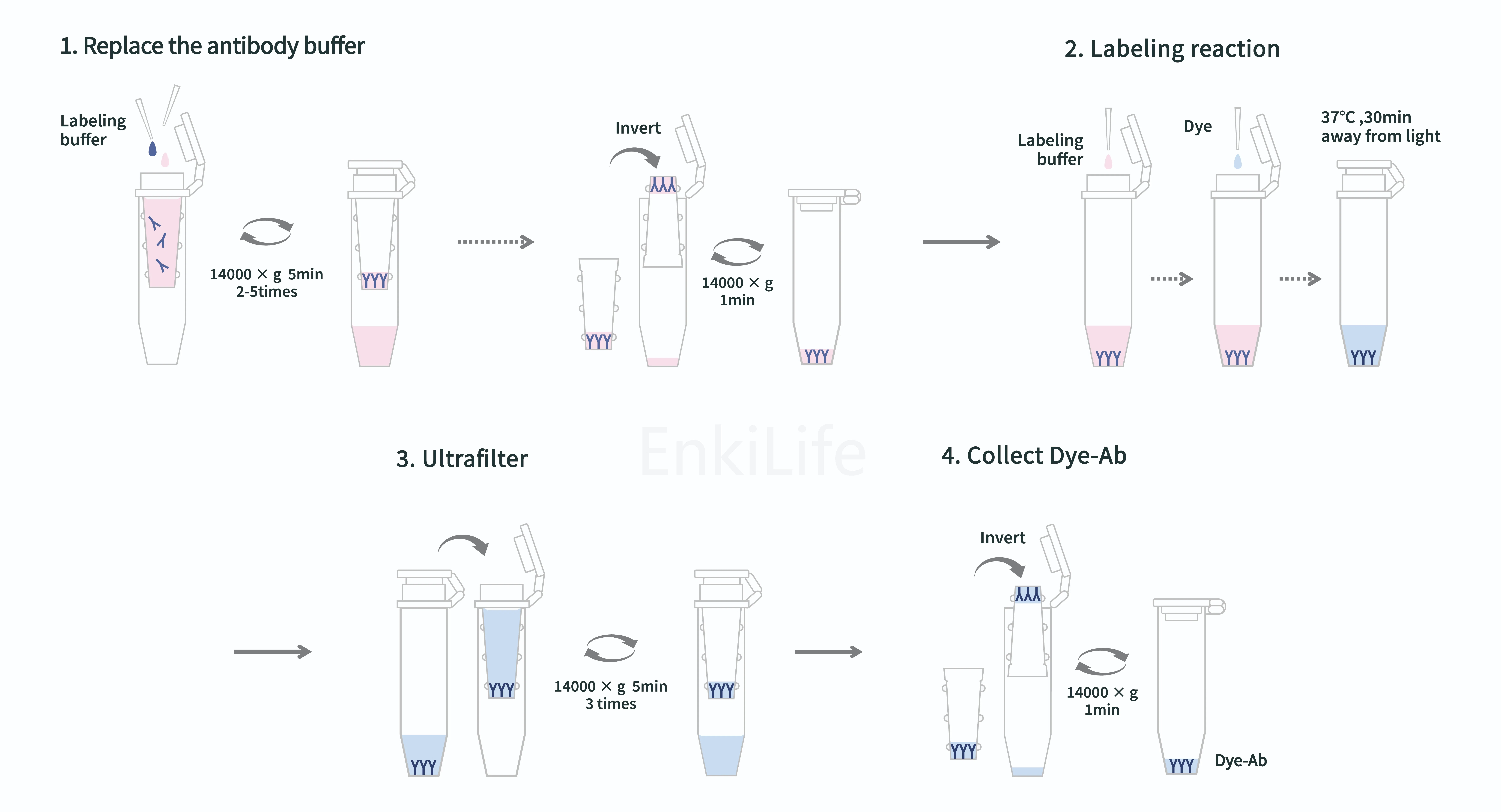
Standard Labeling Procedure
- 1.Ultrafiltration for buffer exchange and concentration
- 2.Labeling reaction
- 3.Purification
- 4.DOL calculation, collection and storage