
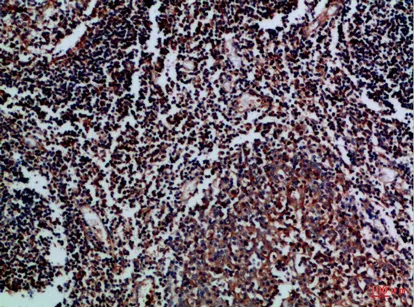
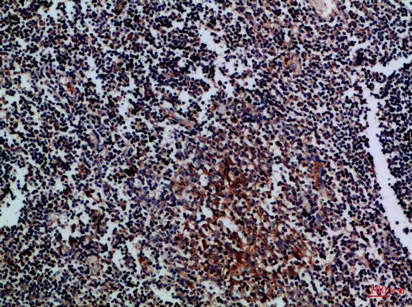
Size:50μL Price:$118
Size:100μL Price:$220
Size:200μL Price:$380
Application:IHC,ICC/IF,ELISA
Reactivity:Human,Mouse
Conjugate:Unconjugated
Optional conjugates: Biotin, FITC (free of charge). See other 26 conjugates.
Gene Name:CD70 CD27L CD27LG TNFSF7
Summary
Performance
Immunogen
Application
Background
The protein encoded by this gene is a cytokine that belongs to the tumor necrosis factor (TNF) ligand family. This cytokine is a ligand for TNFRSF27/CD27. It is a surface antigen on activated, but not on resting, T and B lymphocytes. It induces proliferation of costimulated T cells, enhances the generation of cytolytic T cells, and contributes to T cell activation. This cytokine is also reported to play a role in regulating B-cell activation, cytotoxic function of natural killer cells, and immunoglobulin sythesis. [provided by RefSeq, Jul 2008],function:Cytokine that binds to CD27. Plays a role in T-cell activation. Induces the proliferation of costimulated T-cells and enhances the generation of cytolytic T-cells.,similarity:Belongs to the tumor necrosis factor family.,subunit:Homotrimer.,
Research Area
Cytokine-cytokine receptor interaction;