
Matrix Effect of Samples in ELISA and Its Solutions
The matrix refers to all components in a sample except the target analyte, such as proteins, lipids, salts, pigments, and small-molecule organic substances in the sample matrix. The matrix effect is a phenomenon where these matrix components interact with the target analyte or the analytical system, interfering with the separation, extraction of the target analyte or the detection response, and ultimately causing the analytical results to deviate from the true values. This type of interference is widely present in biological samples such as serum, plasma, cerebrospinal fluid, tissue homogenates, and cell culture media, and is a common cause of poor repeatability and inaccurate quantification in ELISA experiments.
I. Mechanisms of Sample Matrix Effect
1. Direct Competitive Binding to Binding Sites: Certain proteins or small molecules in the matrix may bind non-specifically to the antigen-binding sites of antibodies, or compete with the target antigen for binding to antibodies, resulting in the inhibition or enhancement of the detection signal.
2. Affecting the Reaction Environment: Ions, pH buffering substances, lipids, and other components in the matrix may alter the pH value, osmotic pressure, or viscosity of the reaction system. This affects the efficiency of antigen-antibody binding or interferes with enzyme-catalyzed reactions.
3. Interfering with Signal Detection: Colored substances, fluorescent substances, or enzyme inhibitors in the matrix may directly interfere with signal reading, leading to distorted signal values.
4. Physical Adsorption Interference: Macromolecules in the matrix may non-specifically adsorb onto the surface of the microplate, or bind to detection antibodies or enzyme conjugates. This increases the background signal and masks the true target signal.
Ⅱ. Evaluation Methods for Matrix Effect
To determine the degree of matrix effect, experimental verification is required. Common methods include:
1. Post-Extraction Spiking Method: This method evaluates the matrix effect by comparing the response of the analyte in a pure solution with that in a blank matrix. The blank matrix is obtained by subjecting the sample to pretreatment; it contains no target analyte but retains the matrix components of the original sample.
2. Relative Response Value Method: This method evaluates the matrix effect by comparing the response value of the analyte in a pure solvent with that of the analyte (at the same concentration) spiked into the sample matrix. If there is a difference between the two response values, it indicates the presence of a matrix effect; the greater the difference, the more significant the matrix effect.
3. Calibration Curve Determination Method: Calibration curves are constructed separately using the sample blank, reagent blank, and standard solution blank as the matrix. The degree of matrix effect is evaluated by comparing the linear slopes of these calibration curves. If there are differences in the slopes, it suggests that the matrix has an impact on the response of the analyte.
4. Recovery Experiment: A standard target antigen of known concentration is added to matrix samples with different dilutions, and the ratio of the actual detected value to the theoretical value is calculated. If the recovery rate deviates from the range of 80% to 120%, it indicates the presence of a significant matrix effect.
III. Key Solutions to Address Matrix Effect
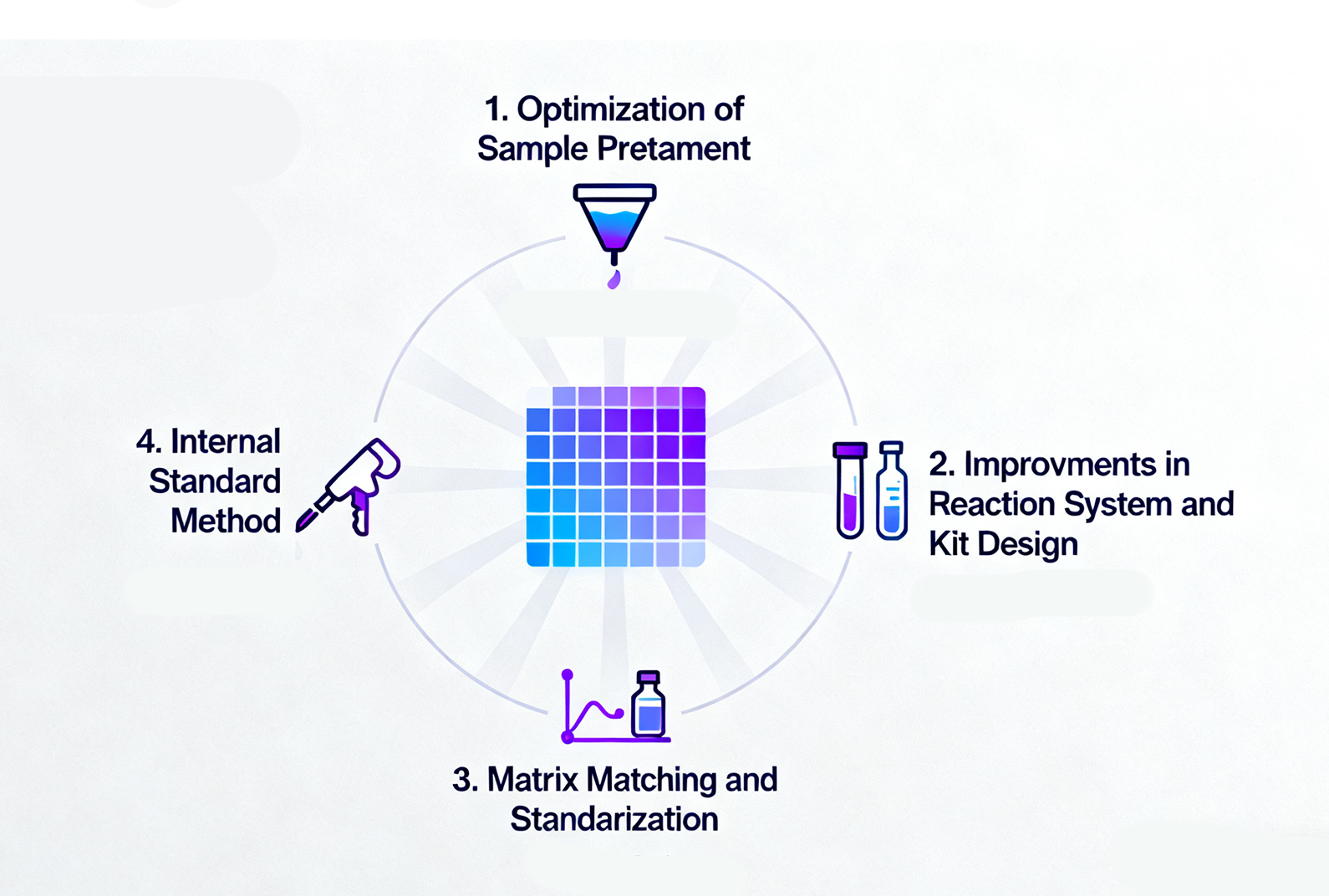
1. Optimization of Sample Pretreatment
Dilution Method: The concentration of matrix components is reduced by appropriately diluting the sample to minimize their interference with the reaction. However, two points should be noted: excessive dilution must be avoided to prevent the target analyte concentration from falling below the detection limit; meanwhile, it is necessary to verify whether the matrix effect is significantly reduced after dilution.
Extraction and Purification: Methods such as Solid-Phase Extraction (SPE), QuEChERS (Quick, Easy, Cheap, Effective, Rugged, Safe), centrifugal ultrafiltration, and nitrogen blow-down are used to separate the target analyte from interfering matrix components. This approach is particularly suitable for complex matrices.
Defatting/Deproteinization: For high-protein and high-lipid samples (e.g., blood, meat), the main interfering matrix components can be removed through precipitation, centrifugation, freeze-defatting, and other methods.
Derivatization: The target analyte is derivatized to increase the difference in physicochemical properties between the analyte and matrix components, thereby reducing their interaction.
2. Improvements in Reaction System and Kit Design
Optimization of Buffer Formulation: Blocking agents or competitive inhibitors are added to the reaction buffer to block the non-specific binding between matrix components and antibodies. Enzyme stabilizers are also incorporated to reduce the impact of the matrix on enzyme activity.
Selection of Highly Specific Antibodies: Monoclonal antibodies or screened polyclonal antibodies are used to reduce cross-reactivity with matrix components. Alternatively, recombinant antibodies modified through antibody engineering can be applied to enhance the selectivity of antibodies for the target antigen.
Improvement of Detection Mode: For example, the traditional "one-step method" is replaced with a "stepwise incubation method". Specifically, the sample is first fully bound to the capture antibody; after washing, the detection antibody is added. This modification reduces the competitive binding between the matrix and the detection antibody.
3. Matrix Matching and Standardization
Use of Matrix-Matched Standards: Standards are diluted with the same type of matrix that does not contain the target analyte (e.g., normal serum), ensuring the matrix environment of the standards is consistent with that of the samples. This reduces signal deviation caused by matrix differences. For example, when detecting human serum samples, standards should be diluted with "human serum matrix diluent" rather than simple PBS buffer.
Establishment of Matrix Correction Models: Mathematical algorithms (such as weighted regression and partial least squares regression) are used to correct signal deviations caused by matrix effects. This approach is particularly suitable for batch sample testing or automated analysis systems.
4. Internal Standard Method (Especially Isotope Internal Standard)
An internal standard substance with physicochemical properties similar to those of the target analyte is selected, and the internal standard and the sample undergo pretreatment and detection simultaneously. Quantification is performed by calculating the ratio of "target analyte response value to internal standard response value," which can offset the simultaneous interference of the matrix on both the target analyte and the internal standard.
The essence of the matrix effect lies in the mutual interference between matrix components and the analytical system. To address this issue, strategies must be comprehensively selected based on the characteristics of the sample and the analytical method. In practical work, a combined approach of "pretreatment purification + matrix-matched calibration + internal standard method" is often adopted to minimize the impact of the matrix effect on the results.
Our ELISA kit uses a microplate made of polystyrene, which is pre-coated with antibodies and can be stored at low temperatures for up to one year, saving researchers valuable experimental time. Visit the website to view ELISA kit.
 | Felicia Felicia is a technical support specialist at EnkiLife, with extensive professional experience in antibody development, optimization, and ELISA assay design and application. She is committed to assisting our clients in selecting suitable antibody products, optimizing ELISA experimental protocols, and resolving technical challenges encountered in the process, thereby supporting the smooth progress of their life science research projects. |