
HER/ErbB Family
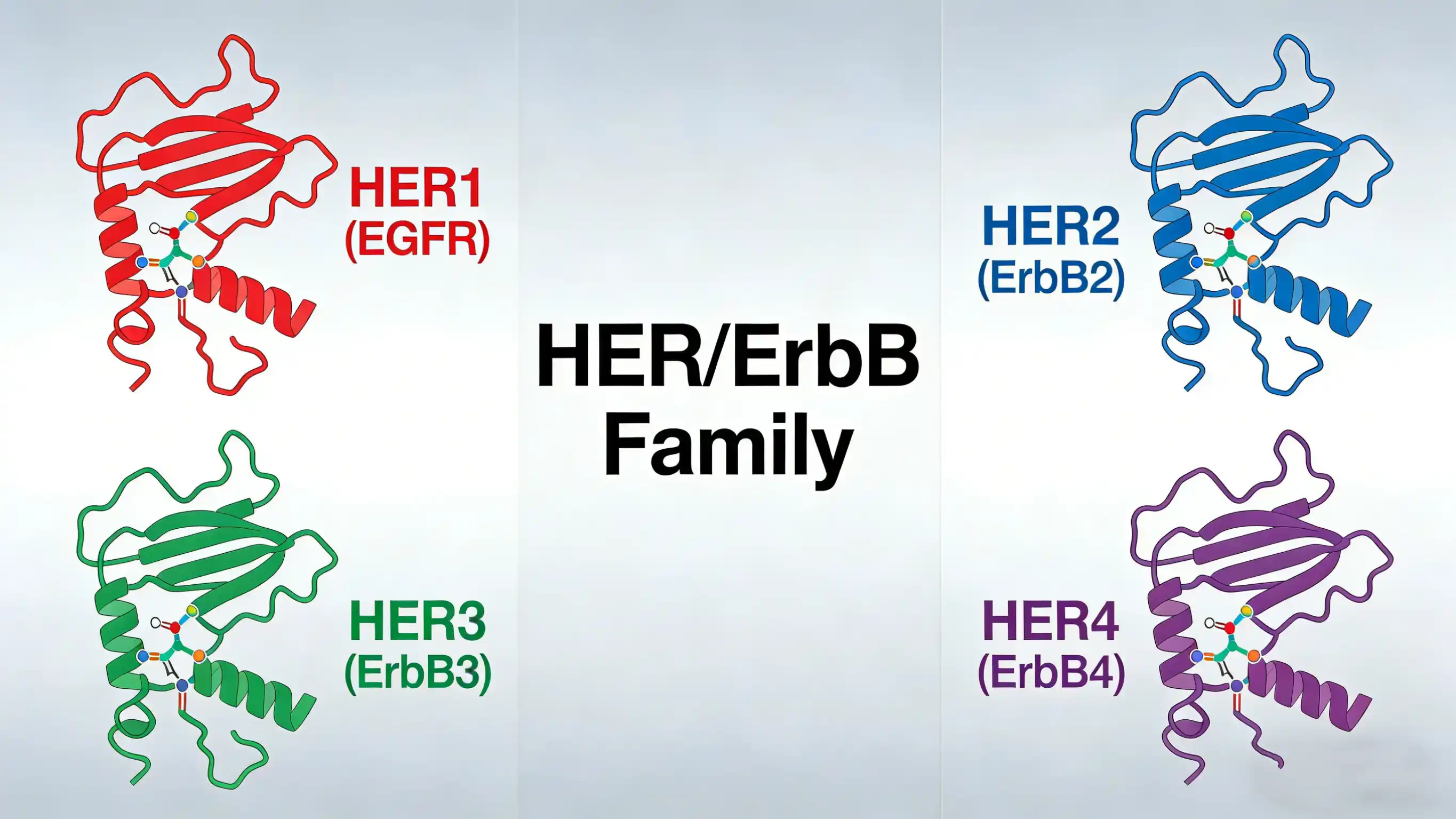
The epidermal growth factor (EGF) receptor is a transmembrane tyrosine kinase that belongs to the HER/ErbB protein family. Ligand binding results in receptor dimerization, autophosphorylation, activation of downstream signaling, internalization, and lysosomal degradation. The GRB2 adaptor protein binds activated EGFR at phospho-Tyr1068.
The ErbB2 (HER2) proto-oncogene encodes a 185 kDa transmembrane, receptor-like glycoprotein with intrinsic tyrosine kinase activity. While ErbB2 lacks an identified ligand, ErbB2 kinase activity can be activated in the absence of a ligand when overexpressed and through heteromeric associations with other ErbB family members. Amplification of the ErbB2 gene and overexpression of its product are detected in almost 40% of human breast cancers. The major autophosphorylation sites in ErbB2 are Tyr1248 and Tyr1221/1222; phosphorylation of these sites couples ErbB2 to the Ras-Raf-MAP kinase signal transduction pathway.
HER3/ErbB3 is a member of the ErbB receptor protein tyrosine kinase family, but lacks tyrosine kinase activity. Tyrosine phosphorylation of ErbB3 depends on its association with other ErbB tyrosine kinases. Upon ligand binding, heterodimers form between ErbB3 and other ErbB proteins, and ErbB3 is phosphorylated on tyrosine residues by the activated ErbB kinase. There are at least 9 potential tyrosine phosphorylation sites in the carboxy-terminal tail of ErbB3. These sites serve as consensus binding sites for signal transducing proteins, including Src family members, GRB2, and the p85 subunit of PI3 kinase, which mediate ErbB-downstream signaling. Both Tyr1222 and Tyr1289 of ErbB3 reside within a YXXM motif and participate in signaling to PI3 kinase.
HER4/ErbB4, like other family members, has four ectodomains, a single transmembrane domain, and a cytoplasmic tail containing the active tyrosine kinase domai. By binding to neuregulins and/or EGF family ligands, ErbB4 forms either a homodimer or heterodimer with other ErbB family members, which results in receptor activation and signaling. ErbB4 is ubiquitously expressed with the highest expression occurring in the brain and heart. The expression of ErbB4 in breast cancer, pediatric brain cancer, and other types of carcinomas has been reported, suggesting that ErbB4 expression is involved in both normal tissue development and carcinogenesis.
Product List
| Target | Catalog# | Product Name | Reactivity | Application |
|---|---|---|---|---|
EGFR | EGFR Rabbit Monoclonal antibody | Human,Mouse,Rat | WB,IHC,IF,IP,ELISA |
Related Products
Super-sensitive ECL chemiluminescent reagent
References
- The HER family as therapeutic targets in colorectal cancer. Ye P, et al. Crit Rev Oncol Hematol. 2022. [PMID: 35462030]
- ErbB-4: mechanism of action and biology. Carpenter G. Exp Cell Res. 2003. [PMID: 12648466]
- Epidermal growth factor-dependent association of phosphatidylinositol 3-kinase with the erbB3 gene product. Kim HH, et al. J Biol Chem. 1994. [PMID: 7929151]
- SH2 domains recognize specific phosphopeptide sequences. Songyang Z, et al. Cell. 1993. [PMID: 7680959]
- Insect cell-expressed p180erbB3 possesses an impaired tyrosine kinase activity. Guy PM, et al. Proc Natl Acad Sci U S A. 1994. [PMID: 8058768]
- Untangling the ErbB signalling network. Yarden Y, et al. Nat Rev Mol Cell Biol. 2001. [PMID: 11252954]
- Activation of ErbB2 during wallerian degeneration of sciatic nerve. Kwon YK, et al. J Neurosci. 1997. [PMID: 9334404]
- More about: prognostic importance of low c-erbB2 expression in breast tumors. Dittadi R, et al. J Natl Cancer Inst. 2000. [PMID: 10974087]
- Heterodimerization of epidermal growth factor receptor and wild-type or kinase-deficient Neu: a mechanism of interreceptor kinase activation and transphosphorylation. Qian X, et al. Proc Natl Acad Sci U S A. 1994. [PMID: 7509075]
- Controlled dimerization of ErbB receptors provides evidence for differential signaling by homo- and heterodimers. Muthuswamy SK, et al. Mol Cell Biol. 1999. [PMID: 10490623]
- Controlling epidermal growth factor (EGF)-stimulated Ras activation in intact cells by a cell-permeable peptide mimicking phosphorylated EGF receptor. Rojas M, et al. J Biol Chem. 1996. [PMID: 8910327]
- The EGF receptor as central transducer of heterologous signalling systems. Zwick E, et al. Trends Pharmacol Sci. 1999. [PMID: 10577253]