
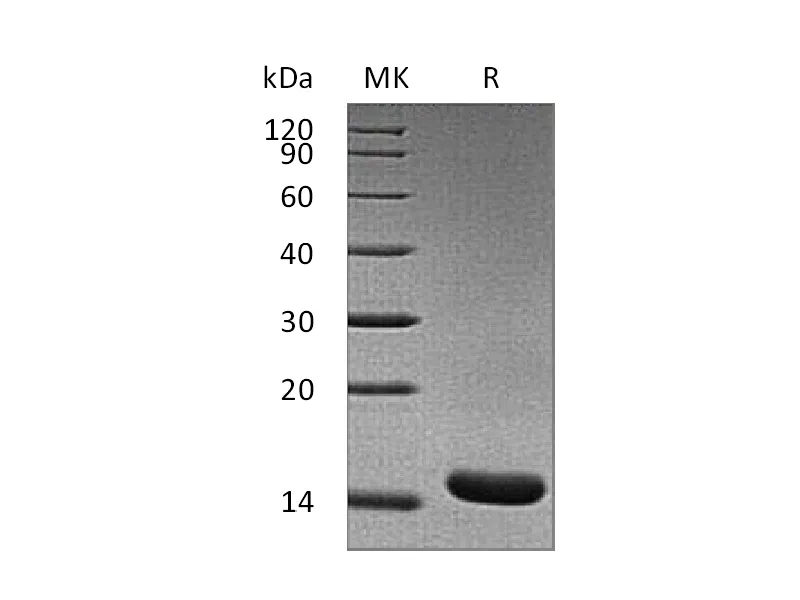
| Name | Recombinant Rat TNF alpha |
| Purity | Greater than 95% as determined by reducing SDS-PAGE |
| Endotoxin level | <1 EU/µg as determined by LAL test. |
| Construction | Recombinant Rat Tumor Necrosis Factor is produced by our E.coli expression system and the target gene encoding Leu80-Leu235 is expressed. |
| Accession # | P16599 |
| Host | E.coli |
| Species | Rat |
| Predicted Molecular Mass | 17.4 KDa |
| Buffer | Lyophilized from a 0.2 μm filtered solution of PBS, pH 7.4. |
| Form | Lyophilized |
| Shipping | The product is shipped at ambient temperature.Upon receipt, store it immediately at the temperature listed below. |
| Stability&Storage | Lyophilized protein should be stored at ≤ -20°C, stable for one year after receipt. Reconstituted protein solution can be stored at 2-8°C for 2-7 days. Aliquots of reconstituted samples are stable at ≤ -20°C for 3 months. |
| Reconstitution | Always centrifuge tubes before opening.Do not mix by vortex or pipetting.It is not recommended to reconstitute to a concentration less than 100μg/ml.Dissolve the lyophilized protein in distilled water.Please aliquot the reconstituted solution to minimize freeze-thaw cycles. |
Alternative Names
Tumor Necrosis Factor; Cachectin; TNF-Alpha; Tumor Necrosis Factor Ligand Superfamily Member 2; TNF-a; Tumor Necrosis Factor; Membrane Form; Tumor Necrosis Factor; Soluble Form; Tnf; Tnfa; Tnfsf2
Background
Tumor necrosis factor alpha (TNF-alpha, TNFSF2) is the prototypic ligand of the TNF superfamily. Rat TNF-alpha consisits of a 35 amino acid (aa) cytoplasmic domain, a 21 aa transmembrane segment, and a 179 aa extracellular domain (ECD). Within the ECD, rat TNF-alpha shares 94% aa sequence identity with mouse. TNF-alpha is produced by a wide variety of immune, epithelial, endothelial, and tumor cells. TNF exists as a homotrimer and interacts with SPPL2B. TNF is mainly secreted by macrophages and can induce cell death of certain tumor cell lines. TNF is a key cytokine in the development of several inflammatory disorders. It contributes to the development of type 2 diabetes throught its effects on insulin resistance and fatty acid metabolism.
Note
For Research Use Only , Not for Diagnostic Use.