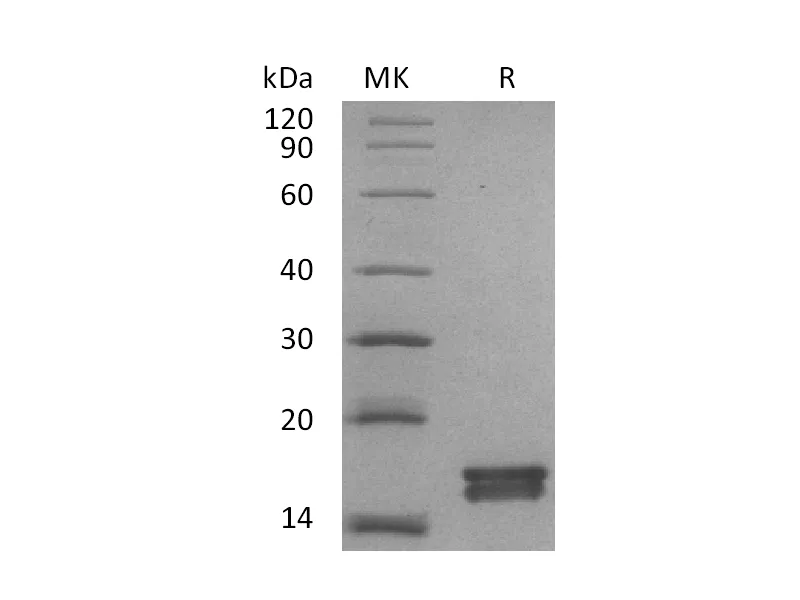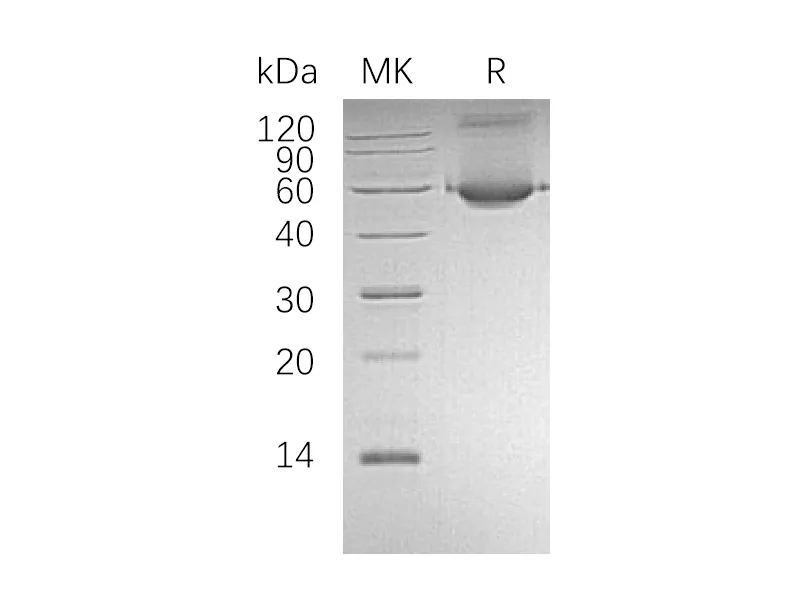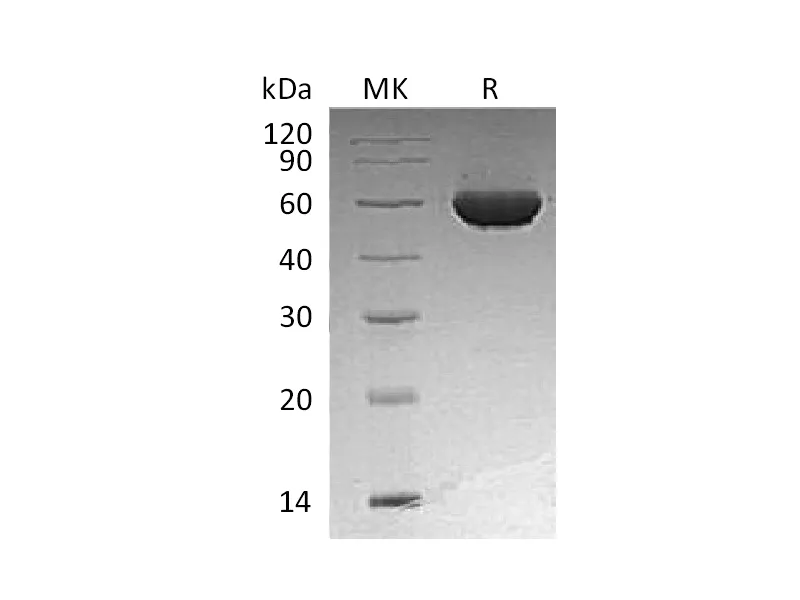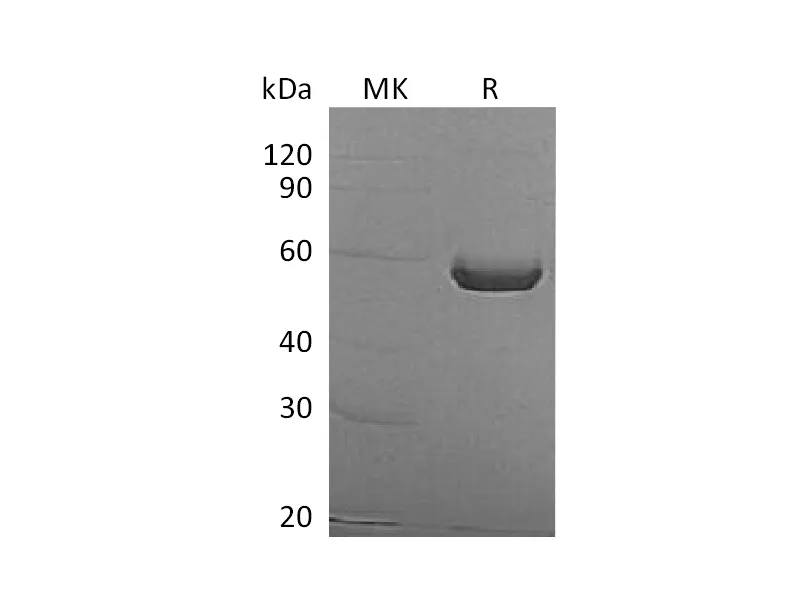



| Name | Recombinant Human S100A4 (C-6His) |
| Purity | Greater than 95% as determined by reducing SDS-PAGE |
| Endotoxin level | <1 EU/µg as determined by LAL test. |
| Construction | Recombinant Human Protein S100-A4 is produced by our E.coli expression system and the target gene encoding Met1-Lys101 is expressed with a 6His tag at the C-terminus. |
| Accession # | P26447 |
| Host | E.coli |
| Species | Human |
| Predicted Molecular Mass | 12.6 KDa |
| Buffer | Lyophilized from a 0.2 μm filtered solution of 20mM PB, 6% Sucrose, 4% Mannitol, 50mM NaCl, 0.05% Tween 80, pH 7.0. |
| Form | Lyophilized |
| Shipping | The product is shipped at ambient temperature.Upon receipt, store it immediately at the temperature listed below. |
| Stability&Storage | Store at ≤-70°C, stable for 6 months after receipt.Store at ≤-70°C, stable for 3 months under sterile conditions after opening. Please minimize freeze-thaw cycles. |
| Reconstitution | Always centrifuge tubes before opening.Do not mix by vortex or pipetting.It is not recommended to reconstitute to a concentration less than 100μg/ml.Dissolve the lyophilized protein in distilled water.Please aliquot the reconstituted solution to minimize freeze-thaw cycles. |
Alternative Names
Protein S100-A4; Calvasculin; Metastasin; Placental calcium-binding protein; Protein Mts1; S100 calcium-binding protein A4; S100A4; CAPL; MTS1
Background
S100A4 is a member of the S100 family of proteins. The S100 family is further classified as a member of the EF-hand superfamily of Ca++-binding proteins. These participate in both calcium-dependent and calcium-independent protein-protein interactions. The hallmark of this superfamily is the EF-hand motif that consists of a Ca++-binding site flanked by two α-helices (helix E and helix F) that were originally identified in a right-handed model of carp muscle calcium-binding protein. Human S100A4 is 101 amino acids (aa) in length. It contains two EF hand domains, one between aa 12-47, and a second between aa 50-85. S100A4 activity has been associated with cell transformation. It seems likely this is either coincidental, or a consequence, rather than a cause of transformation.
Note
For Research Use Only , Not for Diagnostic Use.