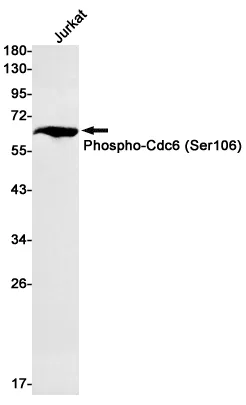



Summary
Performance
Immunogen
Application
Background
CD47 is an integral membrane protein that plays a role in the regulation of cation fluxes across cell membranes. Specifically, CD47 is involved in the increase in intracellular calcium concentration that occurs upon cell adhesion to the extracellular matrix. It is also a receptor for the C-terminal cell binding domain of thrombospondin (SIRP). CD47 is absent from Rh-null erythrocytes, but does play a role in cell adhesion in non-erythroid cells and may prevent premature elimination of erythrocytes. Has a role in both cell adhesion by acting as an adhesion receptor for THBS1 on platelets, and in the modulation of integrins. Plays an important role in memory formation and synaptic plasticity in the hippocampus (By similarity). Receptor for SIRPA, binding to which prevents maturation of immature dendritic cells and inhibits cytokine production by mature dendritic cells. Interaction with SIRPG mediates cell-cell adhesion, enhances superantigen-dependent T-cell-mediated proliferation and costimulates T-cell activation. May play a role in membrane transport and/or integrin dependent signal transduction. May prevent premature elimination of red blood cells. May be involved in membrane permeability changes induced following virus infection.
Research Area
ECM-receptor interaction;